Public radio’s longest-running daily global news program.
©2025 The World from PRX
PRX is a 501(c)(3) organization recognized by the IRS: #263347402.
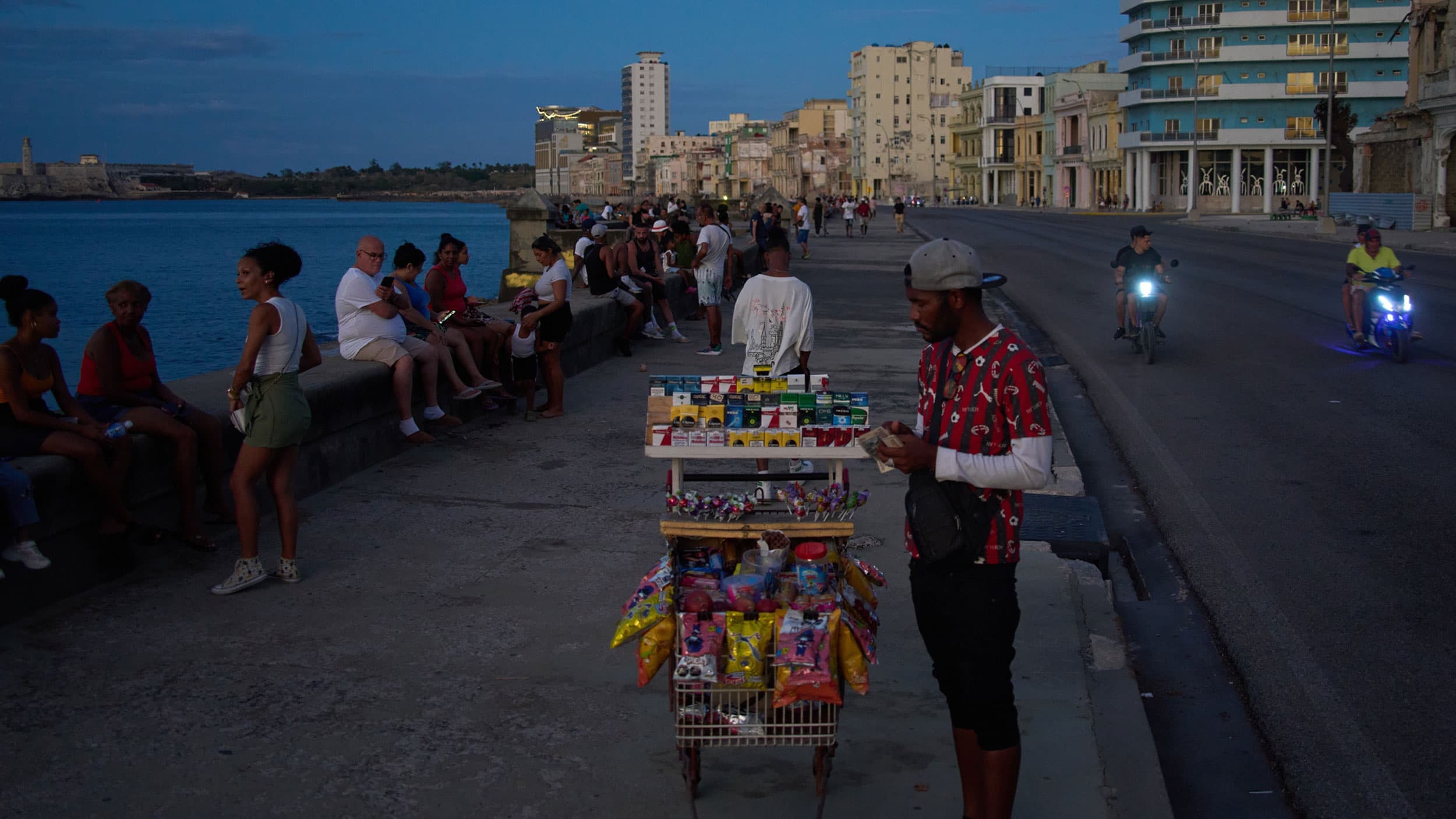
As Cuba faces a deepening energy crisis, Cubans describe how blackouts, scarcity and uncertainty are shaping their lives — and their hopes for change.
A street vendor waits for customers on the Malecón during a blackout in Havana, Cuba, March 16, 2026.
Cuban journalist Abraham Jiménez Enoa left Cuba four years ago, but his family remains in Havana. A few weeks ago, he called his father on his birthday.
“I asked him to step outside so I could see him, because the house was dark and the power was out,” he said.
When his father stepped outside, he turned the camera toward the street.
“I saw a snapshot of my neighborhood,” Jiménez said. “People were cooking over open fires on the sidewalk, breaking apart wooden chairs and tables to use as firewood because they had no cooking gas.”
It was a weekday, but children were not at school, Jimenez said. People stood in doorways and on balconies, with nowhere to go without public transportation available.
“Life was paralyzed,” Enoa added.
Cuba is in the midst of a deepening energy crisis that has left much of the island in the dark for long hours each day. This is impacting basic functions of daily life for the island’s approximately 11 million people.
The crisis has been building for years — driven by aging infrastructure, chronic underinvestment and a heavy dependence on imported oil, much of it supplied for decades at subsidized rates by Venezuela. As those shipments declined over the past five years, the island’s already fragile energy system came under increasing strain.

Since 2024, the country has endured at least five near-total power collapses.
Recent US measures targeting fuel shipments have compounded the strain. President Donald Trump warned of sanctions against countries supplying oil to Cuba, prompting many to pull back.
Facing shortages, the Cuban government has rationed fuel, limiting public transportation and reducing activity in sectors such as health care and industry.
But over the weekend, a Russian tanker carrying roughly 700,000 barrels of crude arrived at the island — the first such delivery in months. Trump has since signaled he may allow countries, including Russia, to resume shipments on a case-by-case basis, easing some of that pressure. Mexico’s President Claudia Sheinbaum has also said her government plans to restart deliveries.
Even so, analysts say the Russian shipment offers only temporary relief, covering roughly 10 to 12 days of Cuba’s fuel needs.

In Havana, residents describe a daily routine shaped by uncertainty.
“When they cut the electricity, it’s like they switch me off, too,” said a woman trained as an engineer, who asked not to be named for fear of repercussions.
She described waking up in the middle of the night to complete basic tasks when power briefly returns.
“I’ve had nights where the electricity comes back at 3 a.m., and I start washing clothes, working — because later, there won’t be power,” she explained.
The outages, sometimes lasting up to 20 hours a day, have affected nearly every aspect of life. Public transportation is limited. Schools are disrupted. In some neighborhoods, people cook over open fires. Signs of hardship are increasingly visible, including people searching through the trash for food.

Speaking from Havana, the engineer said she once believed deeply in Cuba’s socialist system. After decades of hoping for it to work, she now feels disillusioned.
“It didn’t improve. It got worse,” she said. “It didn’t work.”
She believes the government had plenty of opportunities to reform the economy and benefit the private sector, but chose to maintain control instead.
“And we, the people, let ourselves be manipulated,” she added.
Cuba’s economy is shaped by the powerful role of the military, which controls large segments of the country’s most profitable sectors, including tourism, retail and parts of the import-export system. Through conglomerates such as GAESA, a military-run holding company, the armed forces oversee hotels, stores that sell goods in foreign currency and key infrastructure.
Analysts say this concentration of economic power has limited broader reforms and reinforced a centralized model in which the state — and military-linked entities — retain tight control over resources and revenue.
Many Cubans say responsibility extends beyond the Cuban government.
An anesthesiologist in Santiago de Cuba, who also didn’t want to be named for security reasons, said US policy has also played a role, arguing that restrictions affecting the state’s finances — including a decades-old embargo — ripple through every sector.
“If you affect the government’s finances, that affects everything — healthcare, electricity, transportation — because the state controls much of life, and in the end, it affects the people,” he said.
He added that opening the system and loosening state control could create more opportunities, although, he said, such changes appear unlikely.
The Cuban economic model has proven resistant to change, even during periods of attempted opening. Under former President Barack Obama, the United States moved to normalize relations with Cuba, easing travel and trade restrictions and encouraging limited private enterprise on the island.

“There was some opening — private property, access to the internet, people could buy homes and cars,” journalist Abraham Jimenez said. “Things that may sound small, but haven’t been possible for decades.”
“The country started to change,” he added. “But then the government felt it was slipping out of their hands, and stopped those reforms.”
The shift was compounded under Trump, whose administration reinstated stricter sanctions, tightening financial flows and further isolating the island.
For many Cubans, those policies have translated into worsening conditions on the ground.
The anesthesiologist left his hospital job three years ago, saying the salary was unsustainable and the working conditions increasingly precarious.
“We worked with whatever supplies the state could provide,” he said. “And it was never enough.” Under those conditions, he said, he feared making a mistake that could cost a patient’s life.
He added that seeing people searching for food in the trash recently shocked him the most. It’s something he said he’s never witnessed before.
In recent weeks, a humanitarian flotilla organized by left-wing activists and politicians in Europe delivered food, medicine and solar panels to Cuba. But many Cubans remain skeptical.
“For me, it’s political tourism,” the engineer in Havana said, questioning why such efforts draw attention while longstanding domestic grievances remain unaddressed. “The group met with Cuban authorities, but ordinary Cubans who have different ideas just can’t meet with them,” she said.

Jiménez expressed a similar frustration. Barred from returning to Cuba after covering anti-government protests in 2021, he said he cannot even bring basic medicine to his family.
“Why can they enter Cuba, and I can’t bring a pack of aspirin to my father who had a stroke two years ago?” he asked. “Why are they organizing tours on electric buses and public events for the members of the flotilla, when ordinary Cubans don’t even have electricity?”
In Santiago, the doctor said what many Cubans want is simple: the ability to choose their own future.
“I would at least like to try something different,” he said, “to test capitalism, to have options — and let people decide.”
But for many, that choice feels out of reach.
Jiménez said Cubans often feel caught between forces beyond their control — domestic politics, international pressure and ideological battles.
“People treat Cubans like lab rats,” he said. “A way to prove their own ideas on the left, on the right. And in the end,” he added, “what’s left is a country in ruins.”
Despite the hardship, some Cubans still see this moment of tension with the US as a possible turning point.
“There’s sadness,” said a young woman in Havana, who wanted to remain anonymous, “but there’s hope too — that the United States will force Cuban authorities to change. Because they won’t do it without external pressure.”
Even if that change is uncertain, she said she feels they have little left to lose.
Cuban journalist Monica Baro Sanchez, speaking from exile in Miami, said she is wary of expectations that any political shift would quickly transform the country.

“I am not one of those people who think that if negotiations happen, everything will be fine — that we’ll suddenly have democracy and everyone will be happy,” she said. “After 67 years of a totalitarian system, it will take a long time to rebuild the country.”
“But I’m not afraid of freedom,” she added.
Trump has said he would have the “honor” of “taking” Cuba — remarks that have unsettled some Cubans, including Jiménez.
“I want the regime to fall,” he said. “But I don’t want Cuba to become a protectorate — especially not under Trump.”
At the same time, Jiménez added, “for political prisoners, for people who don’t have anything to eat, it doesn’t matter if it’s Trump or the Dalai Lama who changes the situation.”
Eileen Sosin contributed to this report from Havana, Cuba.