Public radio’s longest-running daily global news program.
©2025 The World from PRX
PRX is a 501(c)(3) organization recognized by the IRS: #263347402.
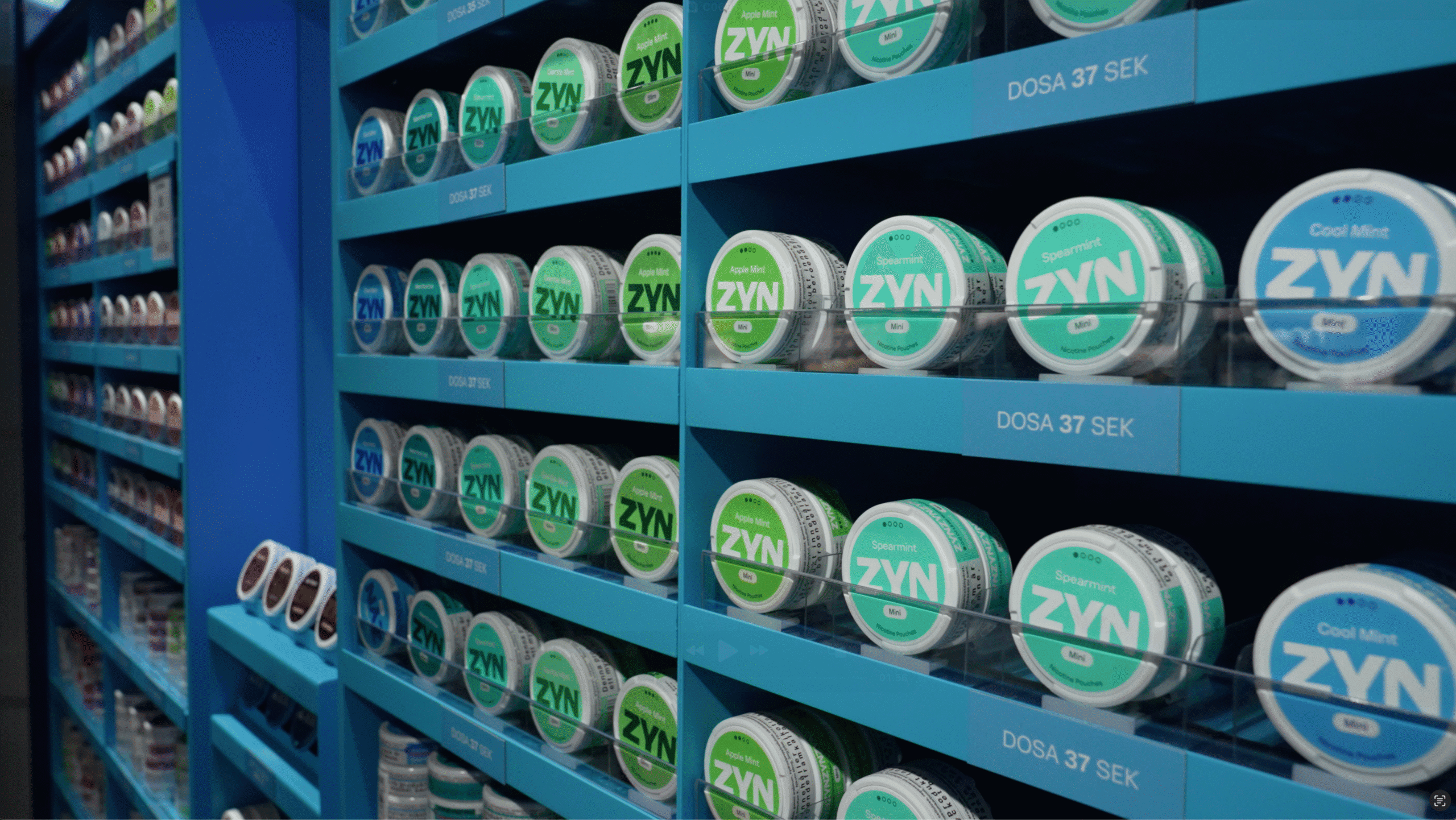
In the US, sales of certain nicotine pouches are soaring. The small white pouches — Swedish cousins of chewing tobacco and dip but without the tobacco leaf — are everywhere on TikTok, flaunted by young creators who pop them under their lips, review flavors and talk about the buzz. One brand dominates the trend: Zyn, a product from Sweden that has quietly become a cultural export. But Swedes are now wrestling with what that popularity means — and whether this habit is saving lives as its promoters claim.
Cans of Zyn on display at the Swedish Match store in downtown Stockholm, Nov. 12, 2025. Swedish Match, a subsidiary of Philip Morris International, is the biggest snus maker in Sweden. Still image taken from a video.
In a back room at the flagship store of Swedish Match, which is reserved for snus-making courses, Patrik Strömer offers a private lesson on how to use Zyn.
To start, he demonstrated placing the pouch under the upper lip — an “upper decky,” as American “Zynfluencers” on TikTok like to say.
“Let it stay there and sometimes your tongue will come up there and try to taste it,” said Strömer, the secretary-general of the Swedish Association of Snus Manufacturers. “If you’re getting dizzy, take it out. You’re not supposed to feel bad about this.”

In Sweden, “snus” is a catch-all term for pouches like the ones Strömer displayed. There are two main types: traditional snus pouches containing ground tobacco and newer nicotine pouches, like the Zyn ones sold by Swedish Match, which Philip Morris has owned since 2022.
While tobacco companies in Sweden have long promoted snus as an alternative to smoking, young people at home and abroad have played a major role in driving up sales of the nicotine pouch variety. As its popularity continues to grow across the Atlantic, countries in Europe are restricting access — with France planning to do so next year.
Yet for many in Sweden, snus is a daily ritual. While tobacco snus has long been banned across the European Union, at least 1 in 5 Swedes are regular snus users.
When Sweden joined the EU in 1995, it was only after securing a special exemption to continue producing and selling this very Swedish tobacco product.

“I try to be a rational person, but I cannot understand that kind of stupidity,” Strömer said. “They have a 25% smoking rate in France. Five times higher than Sweden. They could take a look at Sweden and see what we have done to get two smoke-free generations, but they chose another path. I don’t understand why.”
Tobacco companies have promoted snus as harm reduction, pointing to Sweden’s low smoking rate — the lowest in Europe. On its website, Swedish Match says overall tobacco consumption is comparable to other countries, but deaths from tobacco-related diseases are lower — a paradox the company calls the “Swedish Experience.”
But critics say that story leaves a lot out.
“That’s not true,” said Lisa Lennartsdotter, a tobacco policy expert with the Swedish Cancer Society. “The reason why Sweden has decreased smoking rates are actually classic tobacco control measures.” Sweden was the first country in Europe with smoke-free workplaces, she said, and taxes on tobacco products like cigarettes have increased over time.

Lennartsdotter said comparisons to smoking distract from the unanswered questions about snus itself. Research reviewed by Sweden’s Public Health Agency and the country’s leading medical school, the Karolinska Institute, links snus to a moderately increased risk of diseases like mouth, throat, and pancreatic cancers — as well as a higher risk of Type 2 diabetes and negative outcomes during pregnancy. Long-term research about tobacco snus remains limited, however, and there’s barely any research about nicotine pouches, Lennartsdotter said.
All that aside, smokers aren’t the ones driving the sales of nicotine pouches. “The groups that are picking it up the fastest are the young people — and young women especially,” she said.

About a third of high-school-aged students in Sweden now use snus, according to the country’s Public Health Agency. For years, nicotine pouches were promoted by influencers and handed out for free at festivals and universities. Marketing restrictions introduced in 2022 aimed to limit exposure to people over 25, but Lennartsdotter says they haven’t gone far enough.
“It’s very hard to control who is reached by the advertisement,” Lennartsdotter said, adding that the low price of snus “together with all these candy-like and fruit flavors, that is a good recipe for young people picking up use.”
Anton Ilves, who recently turned 18, told The World that he started using snus when he was 14.
“You get a nicotine rush,” Ilves said. “It makes you feel stronger. I don’t know how, but it’s how I feel.”
He said the habit costs him about a fifth of his paycheck. And now, he also worries about what snus is doing to his mouth.

“I noticed my gums are very … bad right now. Like, it’s damaged up here,” he said, pulling up his lip to reveal a sore area of his gums where he keeps nicotine pouches. “You can wipe your fingers and there’s like dead skin all over. But that’s only from these nicotine pouches. They’re very strong.”
Dentist and oral health researcher Karin Garming-Legert at the Karolinska Institute is studying inflammatory reactions in the mouth linked to nicotine pouches. In a not-yet-published study of 300 people aged 18 to 30, she found lesions, ulcers, inflammation and gum recession among snus users. Symptoms were more severe among users of nicotine-only pouches, she said. Healing is often slow, and long-term impacts remain unclear.

“There is a great need [for] research,” Garming-Legert said. “We don’t know what happens in the body and we don’t know what this local reaction stands for,” in reference to the irritation seen inside the mouths of some nicotine pouch users.
By email, Swedish Match’s Vice President of Communications Peter Hildingsson said the company has “always been clear that those below the legal age should not have access to or use tobacco or nicotine products. We prioritize collaboration with authorities, retailers, legislators and others to uphold the age limit, among others.”
Hildingsson said that two centuries of use in Sweden and four decades of research “demonstrated a significant reduction in tobacco-related diseases” and that Swedish Match is “also clear that using nicotine products is not without risk and that nicotine is addictive.”

“It is known that snus use is associated with a benign reversible lesion known as snus lesions. These lesions are not associated with an increased risk of developing oral cancer. Swedish Match has conducted two clinical studies in snus users who convert to Zyn and both studies demonstrate improvement of the mucosal lesions seen at baseline,” he said, citing research published in 2022.
Patrik Strömer at the Swedish Association of Snus Manufacturers wrote that lesions are a well-known problem for some snus users. And they are reversible.” He added that, “whether nicotine pouches have a different impact than snus pouches, is too early to say.”
But if users have problems with the product, he said, “it is advisable to quit.”