Public radio’s longest-running daily global news program.
©2025 The World from PRX
PRX is a 501(c)(3) organization recognized by the IRS: #263347402.
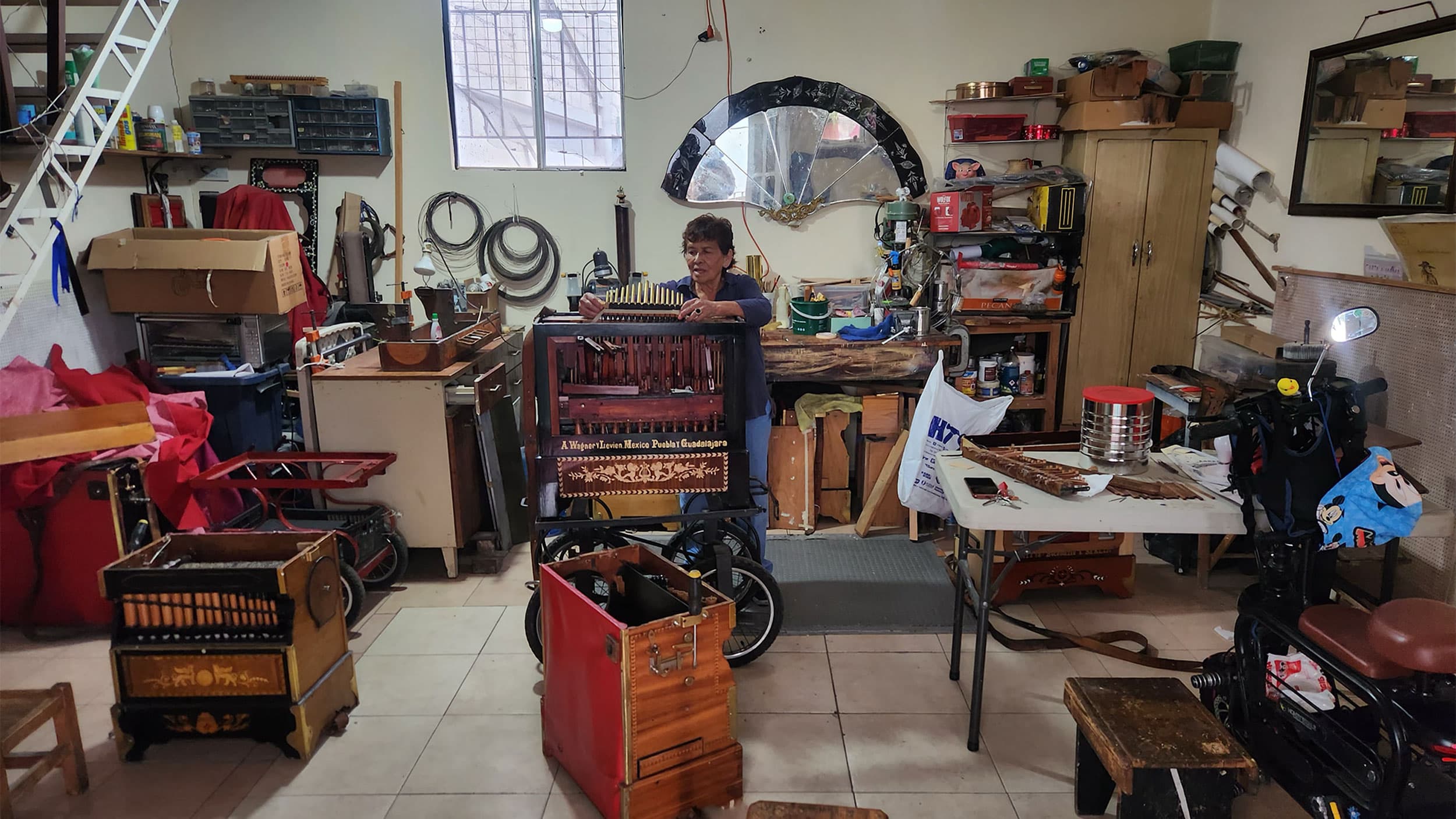
As street music fades in the city, Silvia Hernández restores the instruments — and the culture behind the sound.
Silvia Hernández restores aging street organs at her repair shop in Mexico City’s Tepito neighborhood.
In Mexico City, organ grinders have contributed to the city’s daily soundscape for more than a century. The hand-cranked instruments, usually mounted on carts, were imported from Germany in the late 1800s — and loaded with Mexican songs.
It’s common to hear them in plazas and parks, where players perform in exchange for tips. But today, that sound is fading, as fewer people take up the trade and modern life drowns out their melodies.
Inside a cramped repair shop in the working-class neighborhood of Tepito, 80-year-old Silvia Hernández has been restoring these aging street organs — sanding down wooden cases, fixing broken gears, aligning paper rolls and tuning pipes.

Her husband had been a well-known organillo repairman, but never taught her, believing it was no job for a woman. “You stay in the kitchen, and I’ll take care of the shop,” Hernandez recalled her husband saying to her.
When he died, Hernandez — then a widow with no steady income — began to teach herself, slowly learning the mechanics by disassembling the instruments in his shop.
“I started taking them apart,” she said with a laugh. “I dismantled a cylinder. I began to study the pipes and how to make them work.”

Now, she’s one of just four remaining organillo repair specialists in Mexico City — and the only woman among them.
There are an estimated 500 organ grinders still working in the city today, most of them concentrated around the historic downtown area.

“I’ve always called it the melancholic sound of the historic center of Mexico City,” said Alberto Contreras, dressed in a traditional beige, military-style uniform, who has been organ grinding for years.
In the past, organ grinders carried 100-pound organillos on their backs. Today, most use carts to get around, making the job much more bearable. But the work doesn’t pay very much.
“The most we’ve made is 300 pesos in a good day,” said Alexis Gómez, a 20-year-old grinder — unusually young for the trade. That’s about $15 for a whole day’s work.
He took the job to supplement his income but said he’s already looking for other options.
“People are getting bored,” he admitted. “Most organs play the same old songs and many are out of tune.”
Adding to the challenge, the instruments are no longer manufactured, and few people know how to fix them. For those committed to the profession, it’s about preserving family heritage more than earning a living.
“Our family has been here since 1884,” said Mario Luna, a third-generation organ grinder. “It would be sad to see this disappear.”
“This is how grandparents and great-grandparents met, over organ serenades,” he added.

In recent years, Mexico City’s local government has stepped in to help preserve the tradition. In May, the city held its third annual Organ Grinder Festival, featuring public performances, workshops and demonstrations.
The hope is to formally declare the organillos as part of the city’s Intangible Cultural Heritage — and spark a revival of interest in the artform.
Back in her workshop, Silvia Hernández is now passing on her knowledge to her granddaughter, Samantha. For her, the task is more than technical — it’s deeply personal, as she seeks to continue with the family’s tradition.

Samantha had a message for Mexico City’s residents and visitors: “Support the organ grinders. “Even a small tip helps, wherever you hear their music.”
Together, Silvia and Samantha are restoring the instruments one by one. Each repaired organillo is not just a working machine but a piece of cultural survival.
“Every organ we bring back to life,” Samantha said, “is one more reason this tradition can live on.”