Public radio’s longest-running daily global news program.
©2025 The World from PRX
PRX is a 501(c)(3) organization recognized by the IRS: #263347402.
Commentary: But Congress may not go along as members try to protect bases in their districts.
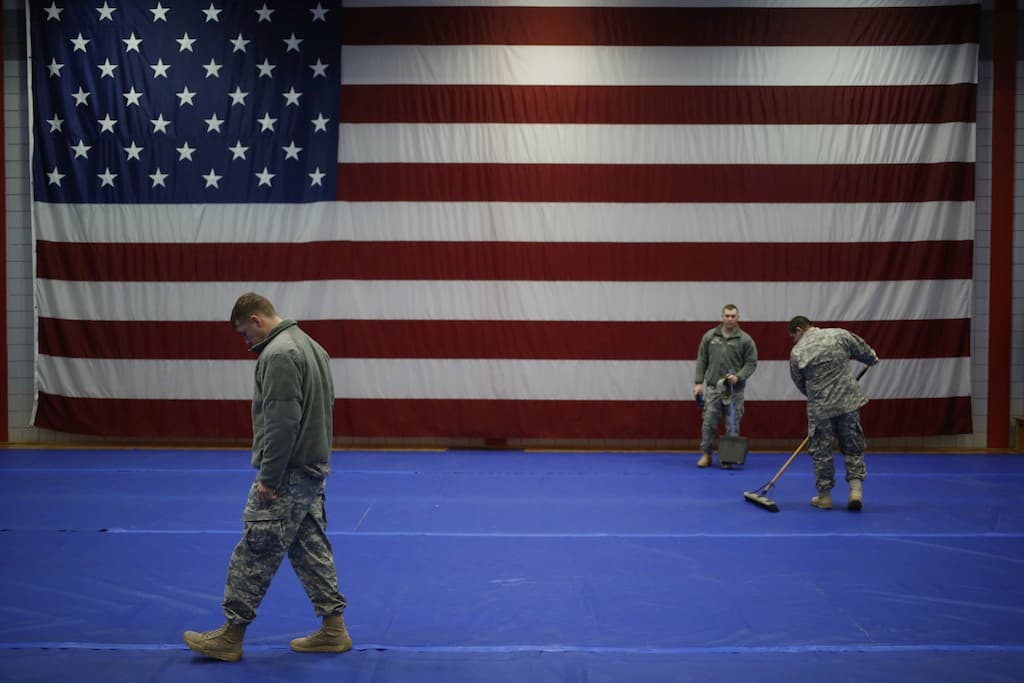
Army soldiers clean the floor of the Natcher Physical Fitness Center following a welcome home ceremony for members of the U.S. Army’s 3rd Brigade Combat Team, 1st Infantry Division on February 27, 2014 in Fort Knox, Kentucky. About 100 soldiers returned to Fort Knox after a nine-month combat deployment conducting village stability operations and working alongside Afghan military and police forces.
OWL'S HEAD, Maine – The good news is that the United States has learned its lessons: we're not only decamping from Afghanistan, even though President Obama insists on checking once again with Afghan President Karzai to make sure he really doesn't want us to stay on, we're clearly also not about to find another third world country to democratize.
To underscore this, is the most overlooked news story of the week: "Pentagon Plans to Shrink Army to Pre-World War II Level" headlined The New York Times.
Remember when, in the 1960s, our military doctrine was the two-and-a-half war policy, deciding that we must be prepared for two big ones and a little one simultaneously?
The Nixon Doctrine took it to slightly less Dr. Strangelove levels; calling for enough military might for one major front and one minor one at the same time, reflecting our Vietnam experience.
But the key to Nixon's approach was his switch to an all-volunteer army, a direct reflection of the behavior of draftees, and prospective draftees, at the height of the Vietnam War.
It was an idea then that seemed a welcome and rational approach to the world that lay head.
The thought was that if you had to rely on a bunch of volunteers, you'd obviously have more committed fighters but you wouldn't have the fodder to plunge into unpopular, Vietnam-like conflicts.
The irony is, at least when it came to Iraq, that it was precisely because we had an all-volunteer army that President Bush was able to start an unnecessary war and then continue it for nearly a decade.
An army of draftees would have, quite quickly, realized that we were seen as occupiers not liberators in Iraq, and would have started reacting in exactly the same way their fathers – those sent to Vietnam and those who didn't want to go – had a generation earlier.
An all-volunteer force, at least up to a point, is like a mercenary army of old; our country's leadership can use it to fight unpopular and unnecessary wars without having to worry about a serious anti-war resistance movement springing up among our fighting-age youth.
It's unfortunate that some sort of required non-military service, an "at home" Peace Corps working in inner cities or poor rural areas, was never initiated for today's draft-age youth.
But that's another issue.
The good news is that Secretary of Defense Chuck Hagel intends to reduce the size of the army to 1940 levels, cutting back nearly 25 percent from its height during the Iraq War.
Part of what makes such large cutbacks possible is the vast improvements in technology. But, as Hagel pointed out in announcing the plan, technology is a two-way street.
"The development and proliferation of more advanced military technologies by other nations mean that we are entering an era where American dominance, in the skies and in space, can no longer be taken for granted."
Hagel's defense cuts were originally stimulated by the Pentagon spending cap legislated in the 2011 Budget Control Act, but bringing defense spending into Congressionally mandated budget guidelines does not mean Congress is going to be happy with the results.
In announcing the budget reductions, Hagel warned that the Pentagon would work aggressively to close unnecessary bases—something that is an anathema to local congressmen and women.
And even as he was rolling out his plan, some members of Congress and retired military officers were gearing up to fight plans to retire the A-10, an Air Force low-level fighter dating back to the 1970s.
The National Guard Association was circulating talking points in Congress aimed at rejecting anticipated cuts. And the naval ship-building industry, supported by representatives from the relevant districts, is going into high gear to oppose any plans to cut back on new ships.
With mid-term elections looming in the fall, both Democrats and Republicans whose districts will be adversely affected by cuts will go on the offensive.
Hagel was upfront about concerns that a smaller army meant greater risk.
"You have fewer troops, fewer ships, fewer planes. Of course there's going to be risk," he said.
But there are advantages, too.
The idea that Bush's two multitrillion-dollar fiascos might keep us from further meddling in faraway countries, where our national interests are not at stake, is wishful thinking.
Ukraine may ultimately precipitate a heavy-handed Russian reaction, and, assuredly, we'll remain on the sidelines.
Yes, we have learned a lesson for the near-term. But, remember, Bush got us into Iraq only 30 years after the last American soldier left Vietnam.
When it comes to learning lessons from history, Americans are no better than the rest of the world.
A reduced military force designed for today's world – and the real risks it poses to the US – might be one step in keeping future presidents from future Vietnams, or Iraqs, or Afghanistans. The cuts are not just a money saver; they are a positive benefit to our strategic position in the world.
Mac Deford is retired after a career as a Foreign Service officer, an international banker, and a museum director. He lives at Owls Head, Maine and still travels frequently to the Middle East.