PRX is a 501(c)(3) organization recognized by the IRS: #263347402.
On Africa trip, Pope Leo XIV condemns war and brushes off Trump criticism
Pope Leo XIV was in Algeria on Tuesday as part of his 10-day visit to African nations. While visiting the Muslim-majority country, the pontiff condemned those who wage war. The pope’s criticism of the US-Israeli war with Iran has drawn criticism from President Donald Trump, who called the faith leader “weak.” To learn more about the trip and Pope Leo’s role in geopolitics, The World’s Host Carolyn Beeler spoke to Mathew Schmalz, founding editor of the Journal of Global Catholicism and professor of religious studies at the College of the Holy Cross.
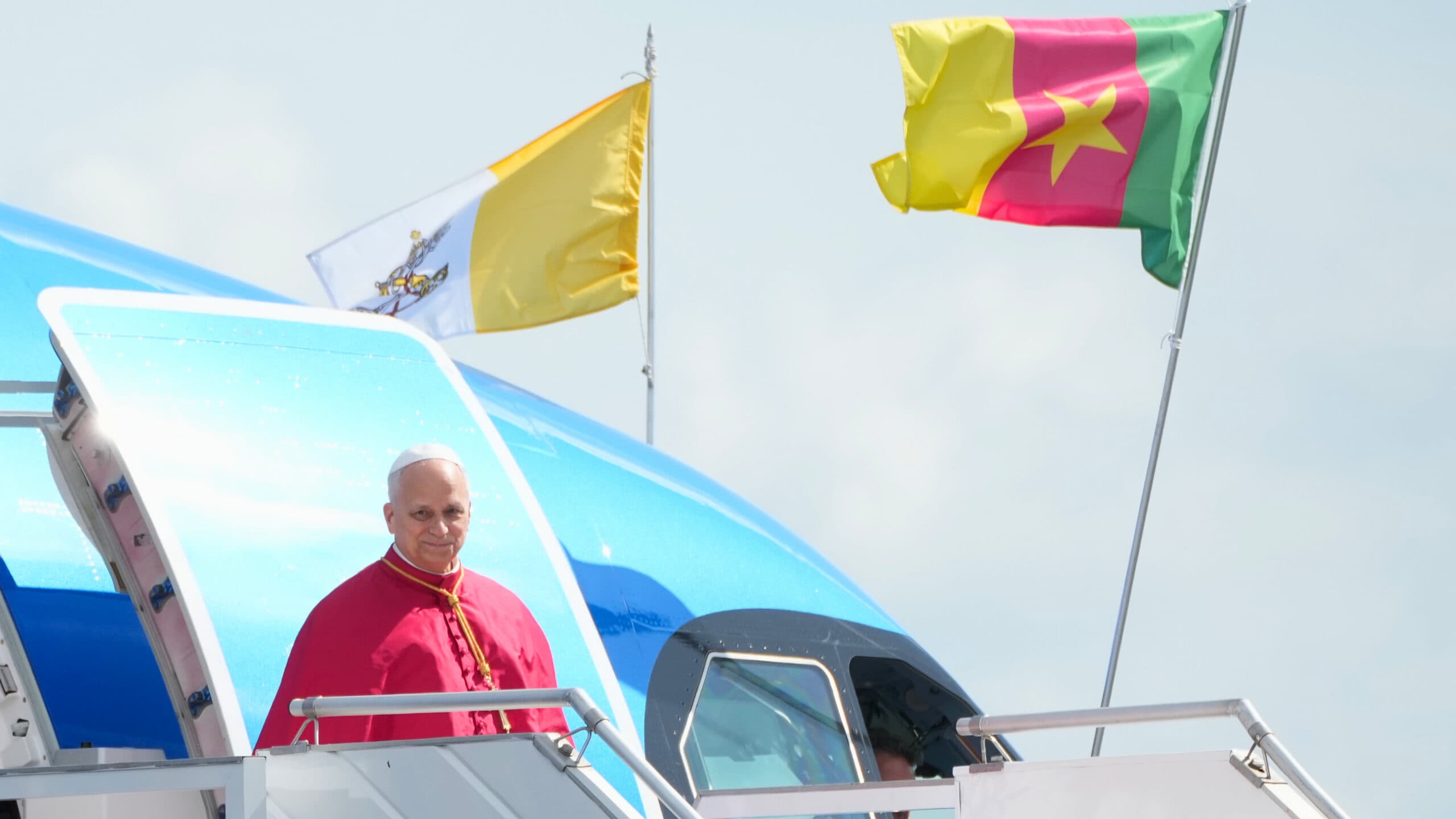
Pope Leo XIV arrives at Yaounde-Nsimalen International Airport, Cameroon, April 15, 2026, on the third day of an 11-day apostolic journey to Africa.
Andrew Medichini/ AP Photo/
Pope Leo XIV is on a 10-day tour of Africa, and he’s using his pulpit to speak out against war. According to him, “violence, despite all appearances, will never have the last word.”
He made the statement on Tuesday at a monument for Algerians who died in their war for independence, during the first-ever papal visit to Muslim-majority Algeria.
The speech followed an unusual exchange between the pope and US President Donald Trump. The pope called Trump’s threats to Iranian civilization truly unacceptable; meanwhile, Trump called the pope “weak on crime.”
To tackle the geopolitical role of the first American pope, The World’s Host Carolyn Beeler spoke to Matthew Schmalz, the founding editor of the Journal of Global Catholicism. He highlighted that Leo is not just a US citizen, he also has Peruvian citizenship and a lot of experience in the Southern Hemisphere.
Schmalz believes that “he really does have the values and concerns of the Global South at heart. That said, most Americans definitely perceive him as the American Pope, and so, his words tend to resonate more strongly within an American context than the words of someone like Popes Benedict XVI or John Paul II would.
Pope Leo XIV arrives at Algiers’ Houari Boumédiène International Airport, April 13, 2026, at the start of an 11-day apostolic journey to Africa. Andrew Medichini/ AP Photo
Carolyn Beeler: I want to switch gears here and talk about the Pope’s visit to African countries. I believe it was two days ago that he arrived in Algeria. Algeria is about 99% Muslim. Why is Pope Leo stopping there?
Matthew Schmalz: For Pope Leo in his vision of the Gospel and also in his global political understanding recognizes that the Catholic Church’s relationship with Islam is particularly important. And so, he’s already been to Turkey, and so, in being in Algeria, he is emphasizing the need for common ground between Christians and Muslims. And also is emphasizing the idea or the fact that Christians and Muslims can work together for the common good.
Pope Leo also has a connection with Algeria because he is the first member of the Augustinian order to become pope. St. Augustine was born in Algeria, right?
He’s also referencing the fact that Christian roots are in Africa, and that’s also acknowledging that there is no question that the center of gravity in global Catholicism has shifted. Africa is not only the most quickly growing part of the Catholic world demographically, but it’s also a center for intellectual life, and his trip to Africa as a whole recognizes this.
A Catholic faithful holds an image of Pope Leo XIV as she waits for his arrival at Yaounde Nsimalen International Airport in Yaounde, Cameroon, April 15, 2026. Welba Yamo Pascal/ AP Photo/
Pope Leo will go on to visit Cameroon and Angola later this week. They’re both places long mired in conflict. I understand that his message there will continue on this theme of anti-war and peace. Is that right?
Yes, and as you correctly identify, both Cameroon and Angola are dealing with a great deal of internal tensions. In the case of Cameroon, it’s what they call the Anglophone crisis between [the] French and English-speaking parts of the country. In Angola, it is wealth inequality and the aftermath of a very brutal and long-lasting civil war. So, in each case, [this] is what Pope Leo is going to be arguing for — is how the Catholic Church can be a force for unity, a force for peace and a force for nation-building and unity within two countries that are still facing deep divisions.
Now, Pope Leo’s final stop will be in Equatorial Guinea, where the country’s leader has been in power for almost 50 years and the government is considered one of the most oppressive in the region. I understand his message there will be about social justice and I’m wondering if you can tell me anything about how a pope threads the needle on a visit like that. On the one hand, wanting to speak out in favor of social justice, but also trying not to alienate a country’s leaders or their supporters. What kinds of things would he be thinking about ahead of this trip?
In Equatorial Guinea, it seems to me that he’s going to speak in general terms about human dignity and, particularly, wealth inequality. Since Equatorial Guinea is trying to develop, again, under its authoritarian leader, a more inclusive understanding of growth that spreads around the country’s oil revenue, I think Pope Leo will encourage that process. And so, he’s not going to criticize the government of Equatorial Guinea directly, but he will draw upon themes such as human rights, equality and so forth that can be applied to the present situation in Equatorial Guinea.
Pope Leo XIV, center, flanked by Cameroon’s President Paul Biya and his wife Chantal, meets with the authorities, civil society and the diplomatic corps in Yaounde Cameroon, April 15, 2026. Andrew Medichini/ AP Photo
So, it’s been almost a year since Pope Leo took over as head of the Catholic Church. Next month marks the one-year mark. I know that Catholics are a large and varied group, but is there a way to sum up how they are seeing him so far?
It seems to me, except for a small but very vocal group in the United States, Catholics throughout the world are welcoming Pope Leo and his leadership. And I think that what’s especially distinctive about Pope Leo is that he is an American, but he lived most of his life in Peru. And so, he’s a bridge. He’s a bridge between the Western Catholic world, shall we say, and the Global South. And so, he himself represents this transition that the Catholic Church is undergoing from what has historically been its Western centers to new centers of religious vitality, particularly in Africa and Latin America.
Parts of this interview have been lightly edited for length and clarity.