Public radio’s longest-running daily global news program.
©2025 The World from PRX
PRX is a 501(c)(3) organization recognized by the IRS: #263347402.
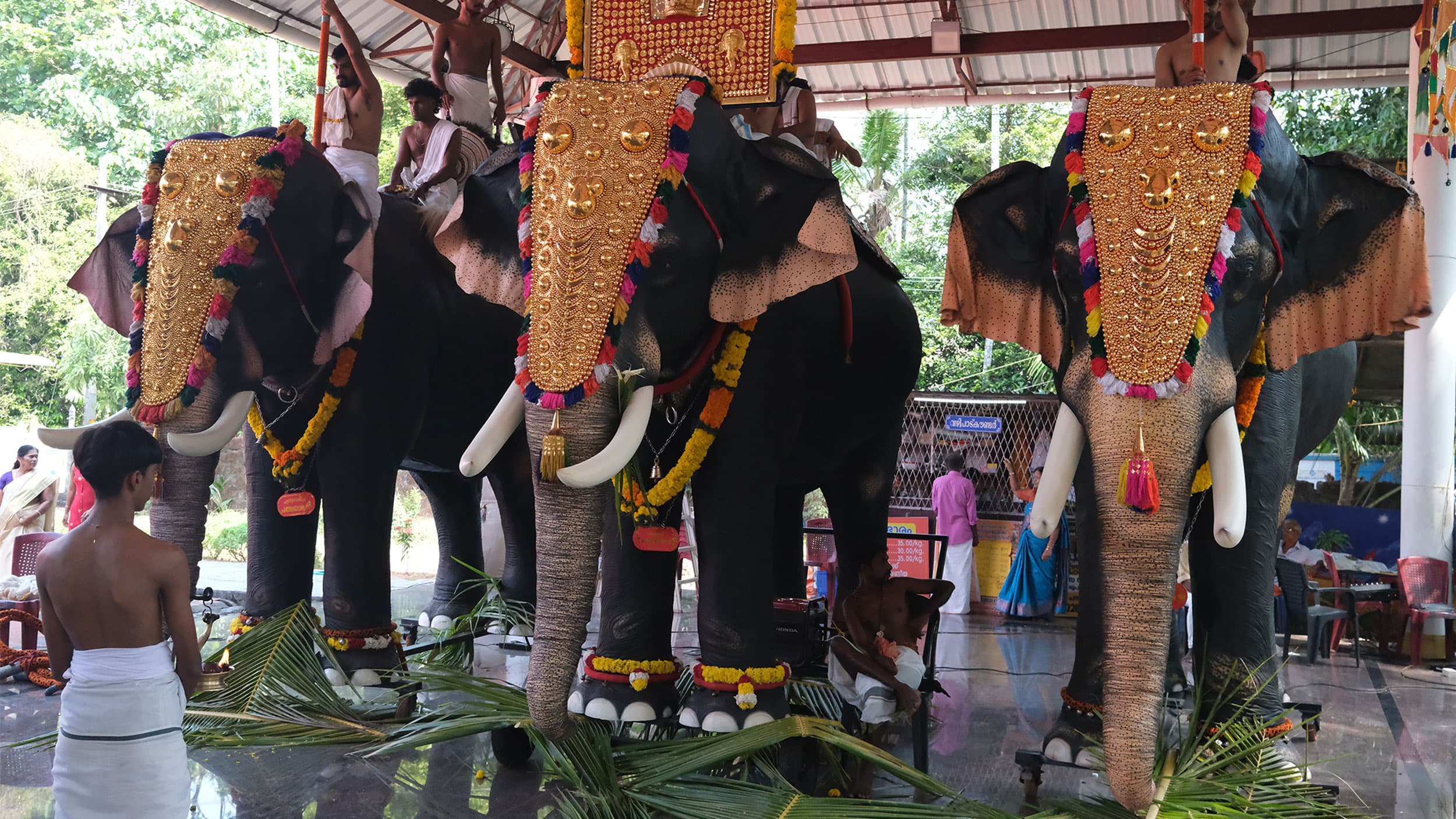
Elephants have been important for Hindu rituals for centuries, but in response to campaigns by animal rights activists, human-elephant conflict and the captive mammals’ declining numbers, artists in India are now creating mechanical elephants as replacements.
Elephants have been important for Hindu rituals for centuries and are believed to bring blessings. People ride them in temples, and dress the animals in golden headwear.
Prasanth Prakashan flicked a switch to activate a piston, making a mechanical elephant’s tail swish from side to side. The artist and model creator said that the fiberglass and rubber elephant can’t walk, but it can move its head, ears and eyes. And it can spray water from its trunk, too.
About 25 employees work at Prakashan’s mechanical elephant workshop in rural Kerala in South India. The team was busy painting eyes and rubber tails, and pulling ropes to make big wobbly grey trunks swing upwards.

The animal rights organization PETA buys Prakashan’s incredibly lifelike, life-sized mechanical elephants, and donates them to Hindu temples in India to replace real elephants used in religious ceremonies.
In Kerala, elephants have been important for Hindu rituals for centuries, and are believed to bring blessings. People ride them in temples, and dress the animals in golden headwear. But PETA has argued that the practice is cruel and needs to end. “The intention is to free the real elephants,” Prakashan said.
His workers pushed a big mechanical elephant onto the back of a truck, then drove down dirt tracks past lush greenery to a nearby village temple. A few hundred villagers came out for the new temple mechanical elephant’s unveiling ceremony. In addition to paying for the fake elephant, PETA has laid out vegan food for the locals for the event.

The mechanical elephant was placed behind a big, thin white sheet on the temple grounds. The shadowy shape of its huge head and tusks could be seen through the veil. Later the sheet was pulled aside, revealing the imposing mechanical creature’s head covered in gold ceremonial headwear. The head moved from side to side as a man threw flower petals at it.
Many temple-goers like to believe that real elephants are praying when they move their heads like this. PETA, however, has claimed that the move is actually a sign of distress.
The villagers chanted and nodded their heads towards the artificial pachyderm. Temple authorities in the town have signed an agreement with PETA to not use real elephants anymore, so now they’ve been given one for free.
PETA India says that since 2023, at least 26 mechanical elephants have been used in temples in South India.
There are around 400 captive elephants in Kerala, out of about 2,500 across all of India. That Kerala count is down by almost half since 2010, generally due to tighter restrictions on owning elephants for shows and ceremonies.

Ujjwal Agrain, a senior policy adviser with PETA India, came down from Delhi to speak at the Kerala temple unveiling. He said the public is coming around to the idea that keeping elephants chained up in temples under punishing sunlight is unethical.
“Now we see these mechanical elephants used in election processions,” Agrain said. “We are seeing [them] used in wildlife sanctuaries for elephant rides. We’re now even seeing [them] being used in … wedding functions. So, there is a change in how people see [elephant use], both in terms of business and, secondly, in terms of empathy and culture.”

At the temple, Anita Sivan, who works nearby as a teacher, watched the mechanical elephant flap its ears. Sivan said it is realistic, and that the mechanical elephant is “80% good.”
She said she misses the “feel of real elephant,” because she grew up with the spectacle of pachyderms in temple ceremonies. However, she said it’s good that elephants won’t face cruelty at this temple any more, and that she even used to see elephants cry during the rituals.

“We could see the tears coming out,” she said. “Those things, they have to face the hot weather, it’s not suitable for their body.” Mechanical elephants, Sivan agreed, cannot cry. She added with a laugh, “They are happy … forever, they are happy.”
Mechanical elephants may not be quite as awe-inspiring as the real thing, but another benefit is that they don’t attack people. In 2025, an elephant killed one person and injured 24 at a religious festival in Kerala. The animal picked a man up by the leg with its trunk and hurled him.
Ashok Kumar, a priest at a small temple in Kerala, said that “normal elephants can create havoc during the festival season.” Kumar’s brother now owns a robot elephant that he also rents to other temples.

Aside from his brother’s business interest and mechanical elephants not attacking people, Kumar also said that the fake elephants don’t stack up next to real ones, saying that PETA is trying to impinge outsider values on Kerala’s elephant traditions.
“It’s an outside influence, outside people,” Kumar explained. “Kerala is following this elephant procession [the trend of mechanical elephants], and that’s a different culture. They [PETA] are trying to destroy that culture … cultural heritage, everything.”
Sooraj Nambiat is another robot elephant artist. He and Prasanth Prakashan are the two main creators of mechanical elephants in Kerala.

Nambiat used to mainly produce elephant models and sculptures, but recently focused his work on mechanical elephants due to rising demand. He said he’s had threats from temple-goers who see his work as endangering Kerala tradition. He referred to the people making these threats as “elephant maniacs.”
“I cannot go to the temple festivals because the temple festivals are managed by the elephant maniacs,” he said. “Whenever they see me, they won’t be good to me. There are a lot of threats: ‘Stop this, otherwise we will be damaging your workshop.’”
Nambiat has only sold a couple of robot elephants to PETA. He focuses on businesses and private buyers, who rent the mechanical creatures out for weddings and other ceremonies.

Although he avoids temple festivals due to threats from “elephant maniacs,” Nambiat said that with captive elephant numbers declining in India, it’s inevitable that artificial elephants will fill the gap. And that when captive elephants eventually run out completely in Kerala, even the “elephant maniacs” will have no option but to use robot elephants.
“These same people will come to me and Prasanth to make their favorite elephant [in mechanical form],” Nambiat said. “They will … buy that elephant. So, I’m waiting for that time.”
Until that day comes, artists like Nambiat and Prakashan will continue to concentrate on developing their mechanical elephants. Currently, both of them are working on models that can also walk.