PRX is a 501(c)(3) organization recognized by the IRS: #263347402.
The future of Burkina Faso’s democracy is in question
The military leader of Burkina Faso has said that its citizens should forget about democracy. The statement came amid ongoing violence and an insurgency that has left thousands dead and displaced. But President Ibrahim Traoré has also developed a cult-like following outside of his country. The World’s Host Marco Werman speaks with Leonardo Villalón, a University of Florida professor who specializes in the region, about what this means for the future of Burkina Faso and West Africa.
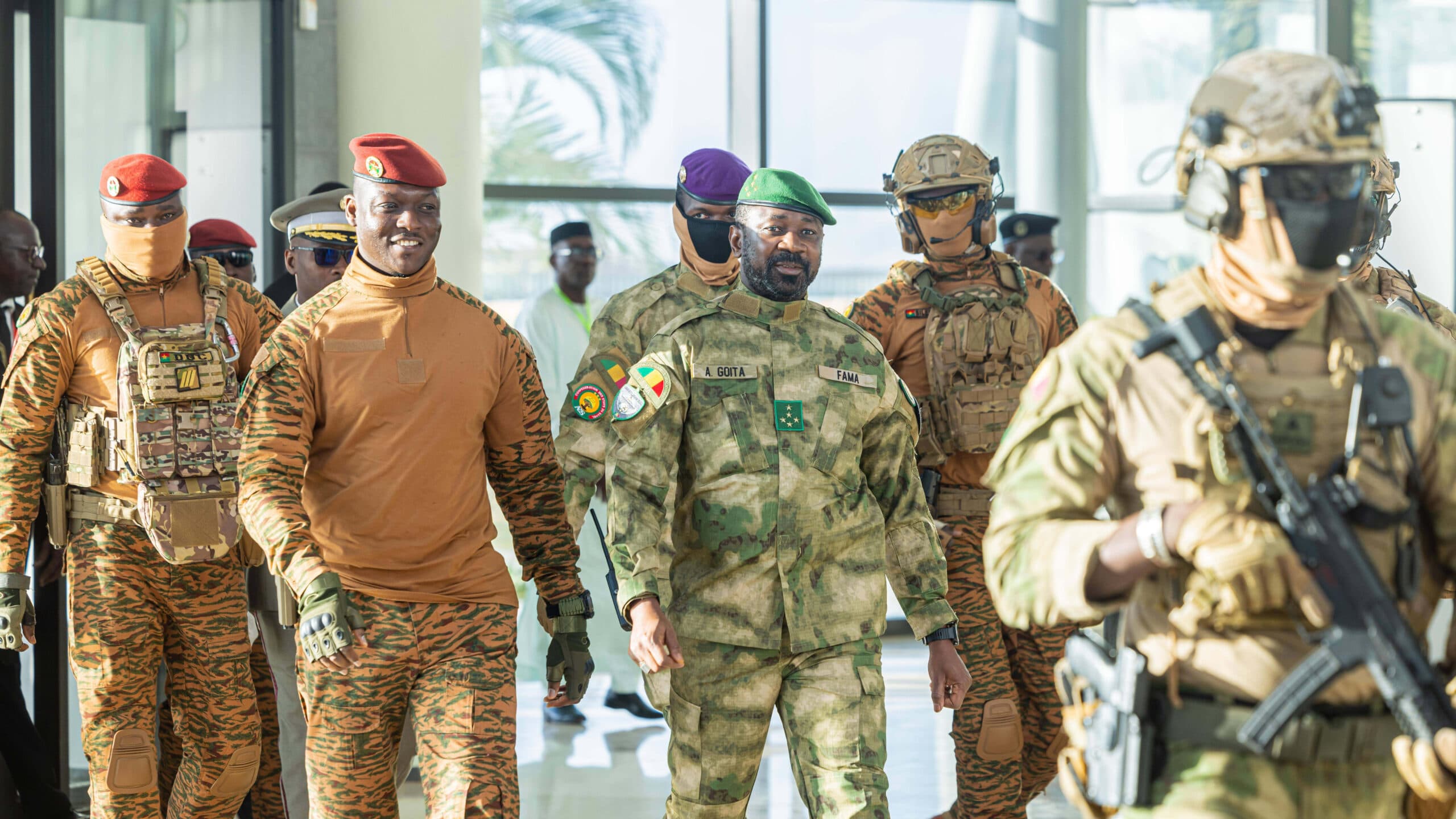
Burkina Faso’s President Captain Ibrahim Traoré, second left, walks alongside Mali’s President General Assimi Goïta during the Alliance of Sahel States (AES) second summit on security and development in Bamako, Mali, Dec. 23, 2025.
(Mali Government Information Center via AP)
In West Africa, Ibrahim Traoré, the president of Burkina Faso, is consolidating power and planning dramatic changes to the government. In an interview earlier this month on national television, he walked back plans for elections that would’ve happened in 2029. Instead, he said, people need to forget about the issue of democracy. “Democracy is not for us.”
Traoré took power in a coup about three years ago, and this month, the government passed a new charter making his leadership indefinite.
When pressed by a journalist what his comments meant for human rights, Traoré responded by saying, “Who’s talking about human rights? Look who bombed Libya and killed children there,” referring to the NATO attack in 2011.
Pakistan closed its two Afghan crossings in Chaman and Torkham, in the northwest Khyber tribal area, almost immediately after NATO aircraft attacked two army posts along the border before dawn on Nov. 26. The supply lines account for 40 percent of the fuel, clothes, vehicles and other “non lethal” supplies for the Afghan war. Fareed Khan/ AP Phile Photo
“Who is bombing far and wide and killing children without distinction? Is that human rights?” he asked. “That’s not what we do.”
But Traoré has also developed a cult-like following outside of his country. Leonardo Villalón, who runs a Sahel research group at the University of Florida, said Traoré has been taking steps toward this for years. Leonardo argues that Traoré’s ability to create a group of international followers while still being a repressive leader is impressive, and it “has given him a lot of leeway to be able to sort of break with past practice.”
Marco Werman: Tell us more about that repression you’re referring to in Burkina Faso that he’s been in charge of.
Leonardo Villalón: Since coming to office, he’s gradually shut down the political process, suppressed civil society, banned political parties, and then people have been arrested and disappearing. He had a practice for a while of conscripting people who had no particular military training and were well past military age and sending them to the front as a means of intimidating people. And so, he’s managed very much to shut down a political space that I think it’s important to emphasize. It was very open despite a lot of military involvement in Burkinabé history. Burkina Faso had a very vibrant civil society and a very vibrant press. And Traoré has managed in both the domestic and then the international climate to get away with shutting that down.
So as you said, he took power in a coup, postponed elections, banned political parties. Were these statements throwing shade on democracy all that surprising?
No, I don’t think they’re very surprising. I think it’s very clear the talk of democracy used to be sort of necessary for military regimes to justify themselves for as long as they could hold on. But I think in the current context, he feels he can abandon that pretense. He’s got the sort of strength at home, but also he’s got some cover internationally, I have to say. Among others, the United States government recently has signaled that promoting democracy is no longer a priority in the region. The US government is starting to reengage with the countries in the Sahel that had previously backed away precisely for violations of human rights and democracy. And so, I think he’s got cover to make those kinds of statements and to get away with them.
Soldiers, loyal to Burkina Faso’s latest coup leader Capt. Ibrahim Traore, are pictured in Ouagadougou, Burkina Faso, Oct. 14, 2022. Kilaye Bationo/ AP File Photo
So just yesterday, the nonprofit Human Rights Watch released a report stating that in Burkina Faso, tens of thousands of people have been displaced in recent years, with nearly 2,000 people killed at the hands of both insurgents and the Burkina Faso military and allied militias. So, what exactly is going on?
That report, I think, was quite interesting. It referred to both Burkina Faso and to Mali, and it referred to the fact that those two countries in particular, along with Niger, have become sort of the epicenter of global terrorism. And what this report pointed out is that the violence that is being perpetrated there is more, not only as much as, but even more on the side of the military and associated groups. And so, we’re seeing somewhere between a very strong insurgency that is being suppressed violently and extraordinary numbers of millions of displaced people right now. Large parts of the country are no longer under the government’s control. And prioritizing the fight against this, I think, sort of what has given Traoré some — he sort of feels that he can prioritize that and he can get away with a lot of things by saying that this is what he’s working on. That’s his priority. That’s what he’s doing.
Now, Leonardo, despite all this chaos, President Traoré is actually very popular outside of Burkina Faso. Why is that?
I think it’s a confluence of factors why Traoré is very popular. He managed to cast himself as the heir to a very popular, charismatic younger leader of Burkina Faso, Thomas Sankara, who died young and was therefore seen as a young revolutionary hero who had tried to break with the chains of colonialism, etc. Traoré has managed to portray himself as the heir to that. And it’s, I think, in a context where there is an awful lot of frustration among young people in particular in West Africa and across West Africa with the failed promises of democracy and development in the early 1990s. Lots of the countries in the region all embraced democratic systems and there’s a lot of hope and aspiration, but now there’s a whole generation that’s grown up since then, who was born and grown up since then and doesn’t feel that that’s worked for them. So, I think he’s managed to tap this sort of reserve of particularly youthful dissatisfaction. He’s been very successful at sort of the anti-Western, specifically anti-French, rhetoric, and he’s been very successful also at tapping into some of that.
People stand next to a statue of Burkina Faso’s revolutionary leader, Thomas Sankara, during his reburial ceremony in Ouagadougou, Burkina Faso, Feb. 23, 2023. Sophie Garcia/AP Photo
If we return to his remarks on democracy on national TV in Burkina Faso, it sounded like a political debate over systems, political systems. But you seemed to suggest earlier that this anti-democratic rhetoric is simply about justifying a single-party state and, to be blunt, Traoré giving himself cover to stay in power as long as he wants. Is that right?
Well, I mean, you know, we have to guess at the intentions, but it’s not hard to guess that the intention may be to prolong his stay in power. But he does have something to stand on in the sense that there is a popular dissatisfaction with democracy in West Africa particularly, but in large parts of the world. There’s always been this rhetoric of, “No, we’re on the road to democracy. Sometimes, you know, we fall off track, but we get back on track.” This is the first time since the early ’90s where in this region somebody just says, “No, never mind, we’re not trying to get democracy at all.” Domestically, it has its opponents, of course. They’re mostly silenced at the moment in Burkina Faso, but he has his supporters, as well, too.
Burkina Faso President Ibrahim Traore arrives to the Grand Palace at the Kremlin in Moscow, Russia, on May 10, 2025. Stanislav Krasilnikov/RIA Novosti via AP, file
Of course, neighboring Mali and Niger, we’ve mentioned them, they’ve also seen coups that brought anti-Western military leaders to power. And these three countries are in clear opposition to the old guard countries still represented economically and tied to the West in this economic bloc known as ECOWAS, the Economic Community of West African States. So Leonardo, what does this moment tell you about the future of, not just Burkina Faso, but the wider West Africa region?
Yeah, the region is clearly at a crossroads, and they’re a pretty significant crossroads. The three countries you just mentioned have actually formally left ECOWAS, and they’re very, very clearly breaking with the model and attempting to suggest an alternative. West Africa is extremely divided as a result at the moment. Some governments, like in Senegal, have attempted to remain within ECOWAS and balance support for it while adopting a little bit of the rhetoric of anti-colonialism and sovereignty that I think appeals to youth. Of course, the big regional hegemonies, Nigeria in particular, but Côte d’Ivoire and Ghana and others, remain within ECOWAS. And there’s a sort of a fork in the road right now [that] we’re seeing in West Africa.
Parts of this interview have been lightly edited for length and clarity.