Public radio’s longest-running daily global news program.
©2025 The World from PRX
PRX is a 501(c)(3) organization recognized by the IRS: #263347402.
The Chinese car manufacturer BYD overtook Tesla as the world’s top EV seller this year. The company has rapidly expanded its operations across the globe, including in Europe. But one plant in Hungary has drawn attention for accusations of labor violations and is now facing an investigation. The World’s Transportation Correspondent Jeremy Siegel gained some exclusive access to information about the allegations.
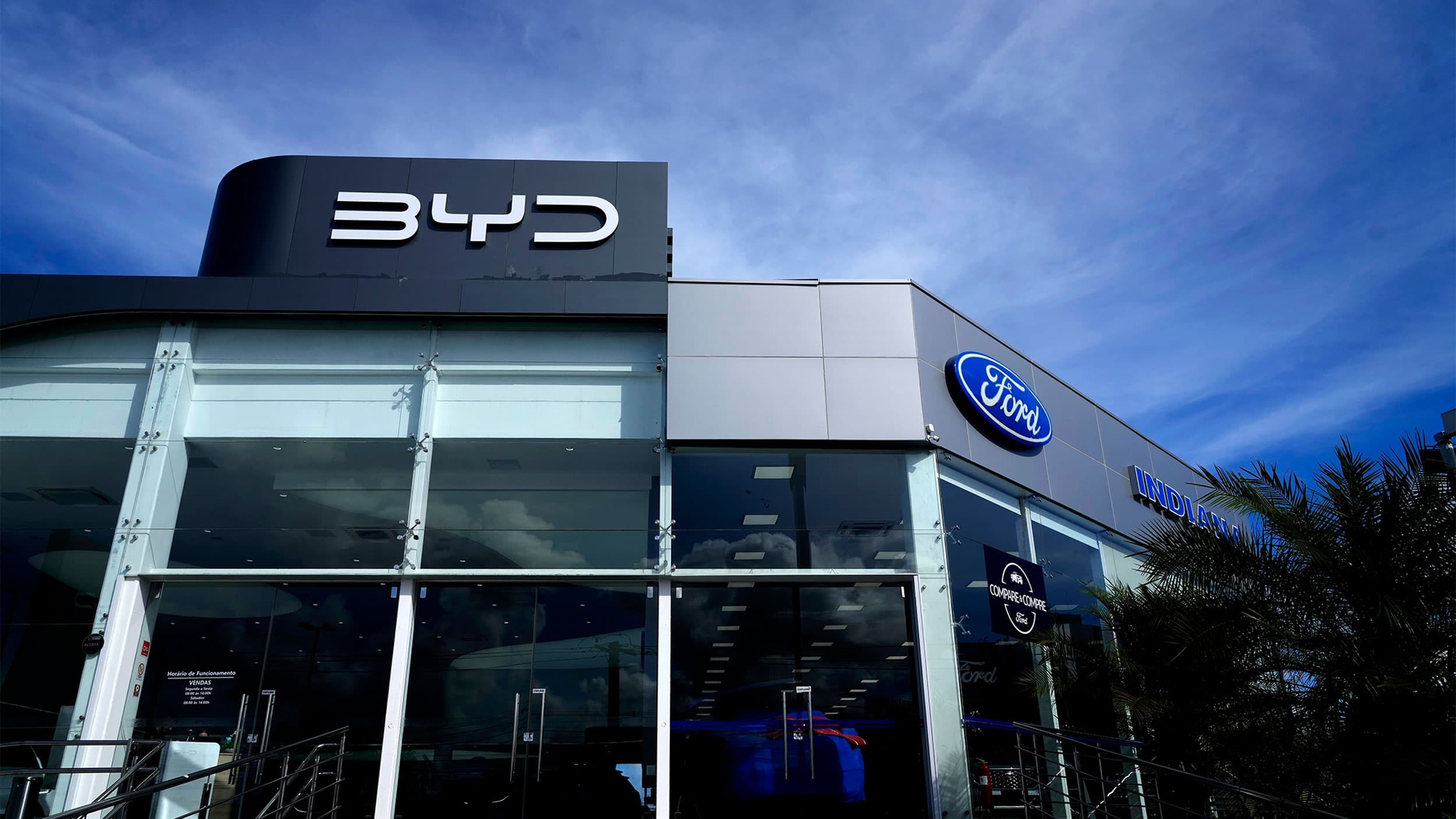
Signs are displayed for dealerships for BYD and Ford in Camacari, Bahia state, Brazil, March 7, 2025.
When BYD Executive Vice President Stella Li took the stage at Europe’s largest auto show in Munich last September, she had big news: The Chinese electric vehicle giant was just months away from assembling cars at its first passenger vehicle construction plant in Europe, located in the southeastern Hungarian city of Szeged.
“We are almost ready to build our cars in Europe, for Europe,” she told the crowd. “Our goal is to build up a local ecosystem for European production.”
Today, BYD is on the precipice of fulfilling that goal, announcing in January that it had begun trial production at its Szeged factory — an essential step in the EV juggernaut’s effort to establish a strategic foothold in Europe. But that mission has had an immense human cost, according to labor rights advocates.

Findings shared with The World by China Labor Watch (CLW), a US-based nonprofit organization that investigates labor conditions affecting Chinese workers around the globe, reveal brutal conditions within BYD’s Szeged facility. Chinese migrant laborers hired to construct the factory, according to the organization, have consistently faced excessive hours, seven-day work weeks, withheld wages and fear of retaliation. A CLW report reviewed by The World — expected to be released to the public next month — found these practices are “clear indicators of forced labor.”
BYD’s new plant, first announced in December 2023, is widely expected to boost the company’s attempt to expand its presence in Europe. By building cars within the European Union, the carmaker will be able to sidestep steep EU tariffs, pumping hundreds of thousands of cheap EVs into the European market without import markups.
Hungarian officials have celebrated news of the plant. In a statement issued shortly after BYD’s announcement that it had chosen Szeged as the site for its new facility, the country’s foreign minister, Péter Szijjártó, said the factory “will be one of the largest investments in Hungarian economic history” and provide thousands of jobs in the region.
According to CLW, the factory has brought roughly 4,000 jobs to Szeged, but many of them haven’t gone to Hungarian residents; Chinese migrant laborers, rather, have been flown in from rural parts of the country on temporary visas to construct the plant at a fraction of the cost of Hungary’s minimum wage. The vast majority of these laborers live on-site in dormitories with roughly 450 residents each, CLW’s report said.
The nonprofit first launched its investigation into BYD’s Szeged factory in September 2025, after a Chinese migrant worker contacted the organization directly to flag exploitative labor practices, said Elaine Lu, a program officer at CLW.
“He told us that he was promised he would return to China after six months of work,” Lu said, but BYD kept “pushing back that date” due to construction delays. The worker was told that if he left before the work was finished, his wages would be withheld, and he’d have to pay his own airfare and visa fees back to China, ostensibly forcing him to continue working in Hungary, according to Lu.
For CLW, this man’s story was a major red flag. The organization proceeded to send a team of investigators to Szeged, where they covertly conducted interviews with 50 workers in total. What they found went far beyond the allegations they received in that first complaint and illustrated widespread, consistent labor law violations.

“This includes things like workers having to put in excessive overtime hours of nine to 10 hours a day,” Lu said. “But then during the summer months [when conditions were more favorable for construction work], they could be working 12 to 14 hours a day. And there were continuous seven-day work weeks. Some workers were putting in 30, 31 days.”
Despite working extremely long hours with no days off, workers did not receive overtime pay, CLW found. The organization also said 20-30% of laborers’ wages were withheld and deposited into bank accounts in China. If workers tried to leave before the plant wanted them to, they would never receive the money.
According to the investigation, workers were instructed to falsify reports of their hours during official inspections and feared retaliation if they spoke out to local authorities. They also lacked access to basic amenities like medical care, because they were not in the country on proper work visas, Lu said.
“I can’t go to the hospital for treatment,” one worker at the BYD factory, who did not share his name for fear of retaliation, told CLW. “I can only rest in the dormitory to recover.”
To further complicate things, many of the workers CLW interviewed weren’t employed by BYD directly but by contractors and subcontractors hired by the automaker, making it difficult to lodge a formal complaint about conditions. Several workers told the organization they didn’t even know who they were working for.
“The major problem that was revealed in this case in Hungary is that you have these multi-layer tiers of subcontractors,” said Eli Friedman, a professor of global labor and work at Cornell University, who specializes in Chinese labor practices. “So, you have the person or the company that’s responsible for the project, and then there’s going to be two, sometimes three, layers of subcontractors between the workers and the company that’s responsible for the project.”

According to Friedman, third-party subcontracting structures are common practice for construction projects on mainland China and are becoming more prevalent internationally as China expands its economic presence in other parts of the world. This practice, he said, can be used to confuse responsibility for workplace violations.
“Whether intentional or not, it does obfuscate who has responsibility in the employment relationship,” he said.
BYD did not respond to repeated requests for comment from The World.
One of the subcontractors employing Chinese migrant workers for the BYD Szeged project, AIM Construction Hungary KFT, (a subsidiary of China-based Jinjian Construction Group Co., Ltd), was reached by phone. A man who was apparently Hungarian answered but quickly hung up after learning that the call was about allegations of labor law violations. The company did not answer ensuing calls from The World and did not respond to emails requesting comment on CLW’s findings.
According to the upcoming report, workers hired by subcontractors like AIM Construction tend to face so-called “recruitment fees” of approximately $1,100-$2,780 for being offered a job. The fees must be paid back to the subcontractors before departure from the worksite.
“For workers originating from low-income regions of China, these fees may constitute substantial debt bondage, effectively forcing workers to remain in place regardless of rights violations, wage shortfalls or substandard working conditions,” the report reads.
In December, CLW’s executive director Li Qiang wrote a letter to government officials in Csongrád-Csanád County, where the Szeged plant is located, outlining his organization’s findings and demanding an investigation.
The letter, shared with The World, details seven apparent violations of Hungary’s labor code, including failure to provide legally required weekly rest periods, systemic excessive working hours, non-payment of overtime and improper use of short-term business visas.

“It is important to emphasize that these problems are not isolated incidents,” Lu said in the letter. “They were consistently observed across different subcontracting teams, dormitory locations and job assignments. The recurrence of these issues demonstrates a systemic pattern, suggesting structural deficiencies in labor management at BYD’s Szeged production base.
CLW also submitted its findings to the European Commission, European Parliament and Hungarian Commission for Fundamental Rights, none of whom returned requests for comment.
A spokesperson for Csongrád-Csanád County’s labor office told The World that local officials are currently conducting an investigation into CLW’s report on conditions at the BYD plant in Szeged, but said “no further detailed information can be provided regarding the ongoing investigation.”
“In Hungary, all laws and regulations must be enforced at all times and complied with by all entities, regardless of whether they are domestic or foreign companies,” the spokesperson said in an email. “The competent authorities conduct inspections across the board, investigate all reported irregularities and, where any violation of legal provisions is identified, impose strict penalties.”
It’s unclear what sort of penalties BYD or its subcontractors could face if government officials confirm CLW’s findings, but the probe threatens the auto-giant’s image as it rapidly expands its presence on the international stage.
Earlier this year, BYD overtook Tesla as the world’s top EV seller, largely owing to a spike in international sales. In a meeting with analysts on Monday, the company said it expects to beat its export targets in 2026, predicting 1.5 million overseas sales this year, 15% higher than initial projections, according to Bloomberg.
To fuel international growth, the Shenzhen-based company has built factories not only in Hungary but also at several other sites outside China, including Camaçari, Brazil. A recent investigation by Brazil’s Public Labor Ministry found widespread labor violations there similar to those alleged at the Hungary plant. Brazilian investigators accused BYD and two of its Chinese labor contractors of “trafficking” migrant workers into the country and forcing them into “conditions analogous to slavery,” according to The Washington Post.
CLW’s Elaine Lu said she expects more cases of exploitative treatment of Chinese migrant laborers to surface in the coming years as Chinese companies like BYD increase their investments overseas. While it’s important for organizations like hers to surface cases of alleged wrongdoing, she argued, responsibility ultimately falls to government officials and companies themselves to prevent — and respond to — workplace violations.
“Chinese workers will continue to be brought overseas to work in these facilities,” she said. “And local governments and local companies will have to grapple with what’s really happening.”