PRX is a 501(c)(3) organization recognized by the IRS: #263347402.
The way we talk about war has changed
There’s been a shift in the rhetoric world leaders are using to describe and justify war and aggression. Especially in the United States, the language is becoming more bellicose, boastful and vengeful. George Soroka, a lecturer in the Department of Government at Harvard University, talks with The World’s Host Carolyn Beeler about how and why the language of global conflict is evolving.
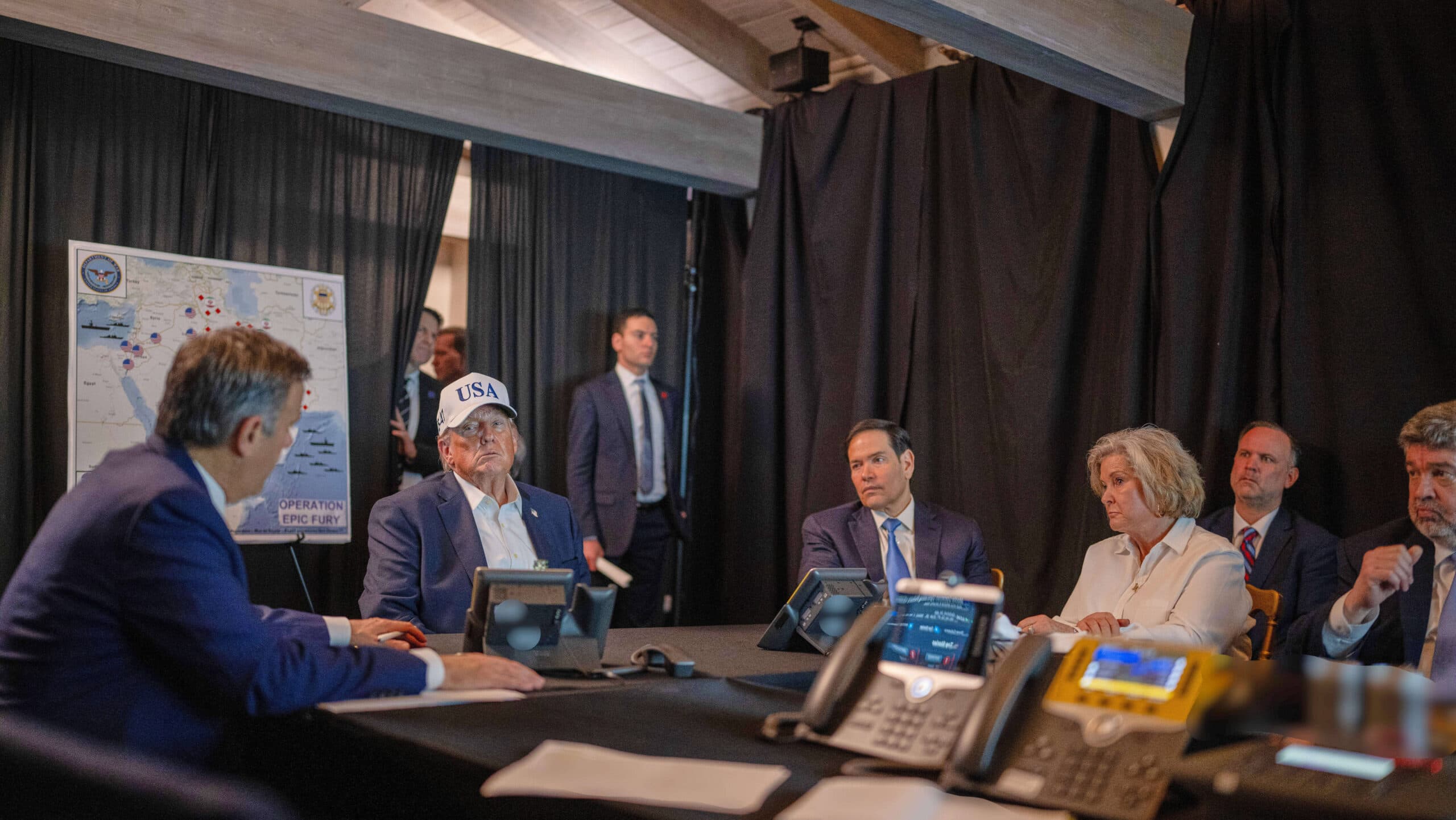
Donald Trump talking with CIA Director John Ratcliffe, left, Secretary of State Marco Rubio, and White House chief of staff Susie Wiles at Mar-a-Lago in Palm Beach, during Operation Epic Fury on Feb. 28, 2026.
The White House via AP/Daniel Torok
Wars are waged on multiple fronts: There’s the obvious one, the fight for control on the battlefield, but a war of words always accompanies that. And in the US, the way leaders are talking about war has changed, becoming increasingly violent and vengeful.
That is especially true for President Donald Trump and Defense Secretary Pete Hegseth. Last week, Trump boasted about Operation Epic Fury, a joint US-Israeli operation in Iran that has brought on global turmoil.
In the past, US intervention abroad was often carefully framed as serving a broader moral purpose, as in George W. Bush’s 2003 announcement of the invasion of Iraq.At the time, he told US troops that “to all the men and women of the United States Armed Forces now in the Middle East, the peace of a troubled world and the hopes of an oppressed people now depend on you.” Those days now seem long gone.
To look more closely at that shift in rhetoric and what its impacts are around the globe, The World’s Host Carolyn Beeler spoke with George Soroka, who teaches a course in politics and propaganda at Harvard University.
Carolyn Beeler: George, as someone who studies rhetoric closely, what did you hear in that cascade of clips about the war in Iran?
George Soroka: Obviously it’s a time of war, we expect aggression; but the pretense of having a rules-bound liberal order is gone. It’s pretty clear that they’re not interested in even selling to the public this idea of building democracy or getting rid of a dictatorship. It’s really about expressing raw power.
George W. Bush obviously used a different tone, as you are saying, it is selling peace and democracy. Do you find that meaningful beyond a difference in rhetorical style?
I do find that meaningful. At the core of it, the intent may have been the same, in both instances. We don’t know what happens in leaders’ hearts. But I think it is meaningful because it sets the discursive frame for the narrative. It sets the reporting that follows on this. It sets the tone for the commentary that pundits follow on this, and you can imagine the polarizing influence of the George Bush clip is not as great as that of the Donald Trump clip.
I want to come back to more examples in a second, but what you just said begs the question, does the way we talk about war actually change what happens to people on the ground? At its most impactful, we’re talking about people being killed. So, does how we talk about that change the facts on the ground?
Well, I think that’s still an open question.That’s a question scholars are grappling with. I think how we frame the narrative around a war, how we framed the enemy really is pretty meaningful. It has to do with vilifying the enemy and thinking about this person as someone who I disagree with, I might even disagree to the point of wanting to kill them, versus someone who is just entirely, irredeemably evil or bad. And the words that are being used are not being couched anymore. I mean, the old liberal order, this pretense of a rule-governed world, or at least the kind of longing for a world governed by rules, institutions and laws has really been done away with. But absolutely, I think leaders play a role and I think that reflects how people think about this all the way down to the military chain of command.
This is not just talk about Iran. President Trump also said he could have the honor of taking Cuba. I was struck by that language. And White House official Stephen Miller, in January, was on CNN’s “State of the Union,” and Jake Tapper asked him why it was okay for the US to grab Venezuela’s president, Nicolas Maduro. And he said, “We live in a world, in the real world, Jake, that is governed by strength, that is governed by force, that has been governed by power. These are the iron laws of the world that have existed since the beginning of time.” What do you hear there?
Honestly, I heard Thucydides 2,500 years ago when he wrote that, ‘the strong do what they will, and the weak suffer what they must.’ I’m seeing a very realist politics. I’m also seeing a very imperial language; it’s not ‘we will,’ it’s ‘I will take,’ … this idea that America can do what it wants. So there’s this interesting mix, with a very transactional side to it: Venezuelan oil will pay for this. But there’s also a really symbolic component of this. There’s a longing for nostalgia. We’re making America great again. The Gulf of America, the renaming of the Gulf of Mexico. So, I guess what is old is new again.
We do have leaders in other parts of the world using similarly bellicose rhetoric. It has been central to what China has called ‘wolf warrior diplomacy.’ A broadcaster on Sky News in Australia described a sharp diplomatic flare-up in late 2025 between Beijing and Tokyo centered on comments by Japan’s prime minister about Taiwan, saying: “And when Japan’s new prime minister said, ‘Well, actually Japan could defend Taiwan if it was invaded.’ Chinese diplomats threatened to ‘cut her dirty neck’ and to ‘break Japanese heads.'” Very graphic there. Do you see that rhetoric as influenced at all by what we are hearing from the White House, or is this a totally separate thing?
Oh, absolutely. I mean, it’s not occurring in a vacuum. You know, the rhetoric has become very zero-sum. Meaning everything is seen in black and white, or at least portrayed outwardly in black and white. And in some ways, that makes sense because right now in an area of social media, sound bites are king. It’s easy to vilify your enemy with a trite quote without really getting into the nuances or complexity of a situation. I was just at a talk the other day where the discussion turned to how JFK and [Nikita] Khrushchev dealt with the Cuban Missile Crisis. They actually exchange letters with one another. And the idea is that they exchange letters because that gives them time to reflect and to be nuanced. One of Khrushchev’s letters, imagine this, in basically a week-long span of time that was so rife with potential for nuclear war, Khrushchev took the time to dictate a six-page letter. And he gets into all sorts of nuances and pleasantries. We don’t have that anymore. We have a very reactive political style. We have a political style in which anyone who doesn’t agree with you is instantly vilified on social media. So absolutely, it’s not occurring in a vacuum. People are taking cues from the United States, from the Trump administration, but I think by the same token, Trump is also taking cues from other world leaders, in particular, Vladimir Putin of Russia.
Khrushchev, of course, being the head of the Soviet Union at the time, who was trading those letters with JFK. So would you argue that this change in language is more a product of the change in medium and less an actual change in underlying policy?
My own take on this, for what it’s worth, is that I think it’s the message that the world leaders we have in power right now are wanting to put out. And this message is being abetted by social media, it’s being amplified by social media, it’s being amplified in a 24-7 news cycle. But I think, ultimately, the message resides with the leaders.
Talk to me more about Putin. I have not studied his language during his tenure in power, but I would guess that it has been forceful for a long time.
It’s been very forceful for a long time, and he actually speaks very much like Trump does. The rhetorical style is very similar. I mean, he’s more polished than Trump is, but the kind of tropes he uses, the kind of memes he uses, the kind of politics, both of nostalgia and politics of grievance, they’re very similar. He came to power when the Second Chechen War was breaking out. He had this famous clip where he talked about wiping out the Chechens in the outhouse. He didn’t use the term “outhouse”; he used a little cruder term, but that went over like gangbusters. I mean, that solidified his popularity. This is a tough guy after all of these ineffective leaders or feet leaders. Finally, we have a real man in power. And I think that has very profound similarities to Trump’s appeal to at least part of the American public.
Last week, Secretary of Defense Pete Hegseth delivered a prayer for the US Armed Forces from the Pentagon. It is expected to be the first of a regular monthly prayer, and the rhetoric in this prayer was notable, as we heard a US official saying America’s targets in combat do not deserve mercy. Do you hear that as a departure?
I hear that very much as a departure, because as he was talking, I was thinking back to the first Iraq war and basically US troops being called off on the march to Baghdad because it was viewed as just being a slaughter and as beneath the US military to continue with such asymmetric power, essentially shooting fish in a barrel, as it were.
I remember in 2003, President Bush, when sending troops into Iraq in 2003, called for saving as many civilians as possible, saying, “I want Americans and all the world to know that coalition forces will make every effort to spare innocent civilians from harm.”That was when he was announcing the incursion.
It’s pretty amazing. And now we have an administration that is not even apologizing for what looks to be the accidental bombing of that school in Iran where all those school children died. I think it’s a pretty profound departure, and also this mixture of the religious element into this, because it almost gives it a kind of prophetic quality. From the US side, we’ve always had in this country, this strand of what used to be called muscular Christianity; this idea that Christians aren’t just meek and turn the other cheek, but they could also be robust and manly and so forth. And that’s really been leaned into by a lot of people in power today. But it’s not only happening here. This is happening in Hungary with Viktor Orbán saying his country should be white and Christian, even though actual levels of Christianity are pretty low in Hungary today. It’s certainly happening with Russia and the way the Russian Orthodox Church has been appropriated to serve the Kremlin’s mission in Ukraine. I mean, there’s no other way to put it, I think, when the patriarch comes out and says, people who fight in the war and die will be absolved of their sins.
George, the US audience is not the only audience for the type of language that we are hearing coming out of the White House. How does this kind of language land with people outside of the US who might be hearing it?
Well, I think it depends on who you are, where you are and how you situate yourself politically. I even know a lot of Iranians or people in the Iranian diaspora; in fact, I was talking to someone who fits that bill just last week, who is really happy with this language … because they hate the regime. And this is not at all to sugarcoat what that regime is like. I mean, it’s a horrific regime. We’ve heard about the massacre of protesters numbering in the tens of thousands. I mean, absolutely horrific. So, it depends would be my answer. But for many people, let’s say in Western Europe, who had been accustomed to this more liberal world order, to a more progressive type of politics, this is all landing like a ton of bricks. I mean, a lot of people have just lost their bearings, including politicians. They don’t quite know what to make of it.
Parts of this interview have been lightly edited for length and clarity.