Public radio’s longest-running daily global news program.
©2025 The World from PRX
PRX is a 501(c)(3) organization recognized by the IRS: #263347402.
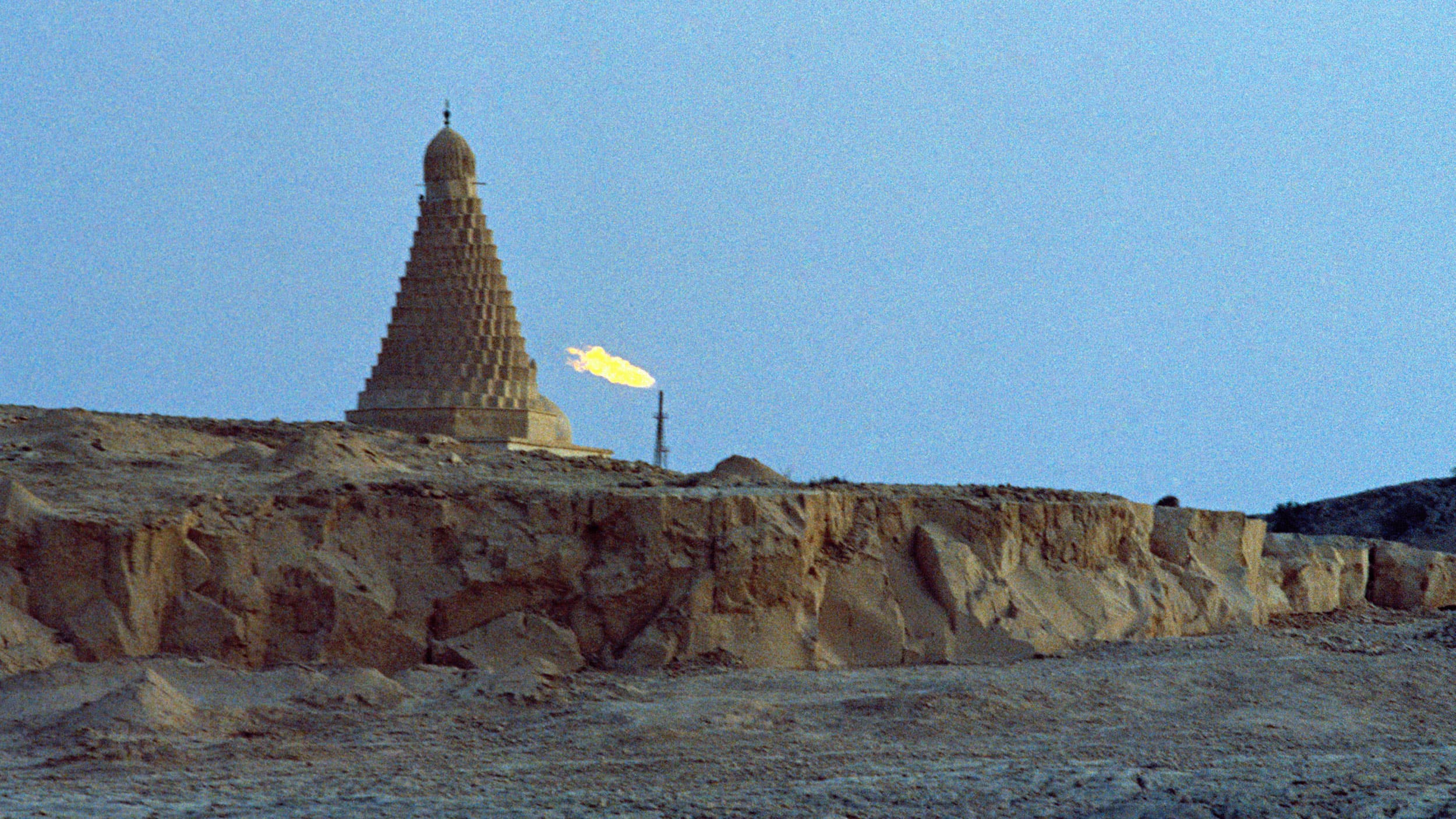
On Mar. 13, the Persian Gulf island of Kharg, which is roughly one-third the size of Manhattan, became the latest target of American jets. US President Donald Trump said that he didn’t order the total destruction of the oil facilities there “for reasons of decency.” Aside from being home to critical oil infrastructure, Kharg Island is also home to a small population, several cultural sites and wildlife.
In this file photo, an ancient mosque and the flame of a petrochemical plant, burning off unwanted gas byproducts, is seen on Kharg island, Iran, July 1971.
On the night of the airstrike on Kharg Island, sirens cut through the quiet.
Red lights flashed across the dark sky, revealing for a moment the island’s maze of pipelines and storage tanks.
US jets hit military targets on the island using bunker-busting bombs.
But the most critical oil infrastructure — the parts that actually move oil out of Iran — were left standing.
US President Donald Trump said that was deliberate.
He framed it as restraint, saying in a social media post that he chose not to destroy the pipelines “out of decency.”
So far, there are no clear details on the number of people possibly killed or injured. Kharg Island not only houses oil infrastructure but is also home to a small population, several important cultural sites and wildlife.
The Iranian government has shut down the internet since the start of the war, making it almost impossible to get accurate information from the ground.
The small civilian population that lives on the island, which sits about 15 miles off of Iran’s coast, is mostly made up of oil workers. These people have now suddenly found themselves caught up in a war centered on the very industry they depend on.
“Kharg Island is a beautiful, coral-rimmed island in the Persian Gulf,” said Alex Shams, an anthropologist who has studied Iran’s islands.
“It’s a desert island, but it’s surrounded by beaches and it’s also a very historic island.”
Centuries ago, Shams added, Kharg was part of a major trading network linking the Middle East to the Indian Ocean. The Portuguese once occupied it, leaving behind forts and traces of that past. There are even ancient monasteries still standing.

Eventually, the Portuguese were driven out of the region, Shams said, but some of their influence remains.
After the discovery of oil in Iran in the early 20th century, Kharg Island became a hub for oil refining and export to the rest of the world.
Because of its significance to Iran’s economy, the government paid attention to its security, Shams explained, setting up military installations for its protection.
But aside from the infrastructure, and maybe somewhat surprisingly, the island is also home to a population of gazelles. Their fate after the US bombings is unclear.
“When we think about war, we often think of the human casualty, and that is really important,” Shams said, “it’s really central. But there are also a lot of animals that are being affected by this war, and … these weapons are often having long-term chemical effects.”
Back in Washington, the rhetoric is still evolving. Shortly after the March 13 attacks, Senator Lindsey Graham went on Fox News to implore Trump to “take Kharg island.”
“Take Kharg island, and the war could be over,” he stated.
But analysts said that idea comes with serious risks.
“The island is within range of Iranian missiles, drones, even artillery,” said Gregory Brew, senior analyst at Eurasia Group.
“Any US troops stationed there would be vulnerable to Iranian counter attack,” he added.
There is also the risk of things spreading further. Iran could pull in allies like the Houthis in Yemen, who have already targeted ships in the Red Sea, a critical route for global trade.
Trump has been inconsistent in his comments about whether he is willing to put American troops on the island. On Thursday, speaking with reporters, he dismissed the idea. But at other times he has said he is not ruling it out.
Meanwhile, the tit-for-tat attacks in the Persian Gulf continue.
The latest target was the South Pars natural gas field, which supplies about 70% of Iran’s gas. It’s not just a domestic lifeline; it’s part of a shared reservoir with Qatar and one of the most important gas fields in the world. Hitting it sends a message far beyond Iran’s borders, into global energy markets already on edge.

Trump publicly blamed Israel for the strike, saying it had “violently lashed out,” while emphasizing that only a “relatively small section” of the field was hit.
Iran responded quickly, launching missiles toward a refinery in Riyadh, Saudi Arabia.
Treasury Secretary Scott Bessent also commented about Kharg island on Fox News.
“If you’re an oil worker, you don’t want to work there,” he said, “so all the oil workers there are being coerced to stay there. And we will see what happens with … whether [Kharg island] will eventually become a US asset.”
For now, though, the future of the island and its inhabitants remains uncertain.
The attacks on Kharg Island show that this war is no longer just about military targets, but also about energy infrastructure and the systems that keep economies running.