PRX is a 501(c)(3) organization recognized by the IRS: #263347402.
Celebrating Eid al-Fitr in one of Islam’s holiest cities
As Ramadan wraps up, Muslims across the globe are preparing for Eid al-Fitr, the “Festival of Breaking the Fast.” National Geographic Explorer Paul Salopek has been walking around the world on foot for the past 13 years for his project, the Out of Eden Walk. He joins Host Marco Werman to talk about the year he spent Ramadan and Eid al-Fitr near the Prophet Muhammad’s mosque in Medina, Saudi Arabia.
As Ramadan, the Islamic month of fasting, comes to a close, Muslims will celebrate Eid al-Fitr, the festival of breaking the fast. It’s marked by three days of communal prayer, family time and, naturally, lots of food.
National Geographic Explorer Paul Salopek has been walking around the globe for the past 13 years, and he’s seen a number of ways Muslims across the Middle East and Central Asia observe Ramadan and Eid Al-Fitr. He’s been documenting these experiences in a project called Out of Eden Walk.
Salopek joined The World’s Host Marco Werman to share experiencing Ramadan in Saudi Arabia for the very first time.
Marco Werman: Paul, Saudi Arabia was really one of the first countries you passed through on your global trek on foot, where you were immersed in the meaning of Ramadan and Eid al-Fitr. What year was it, and how did you get there?
Paul Salopek: Yeah, as you mentioned, my project is across the world. I’ve so far walked through 21 countries — 14 of them were either Muslim or had large Muslim minorities. But Saudi Arabia is the core; it’s the homeland of Islam. It’s basically summertime. Ramadan was, believe it or not, July or August, walking across the deserts of Saudi Arabia. It was a hot time.
I can imagine. Now Saudi Arabia is home to some of the holiest sites in Islam, one of them the Al-Masjid al-Nabawi, the Prophet’s Mosque. Tell us about your visit there.
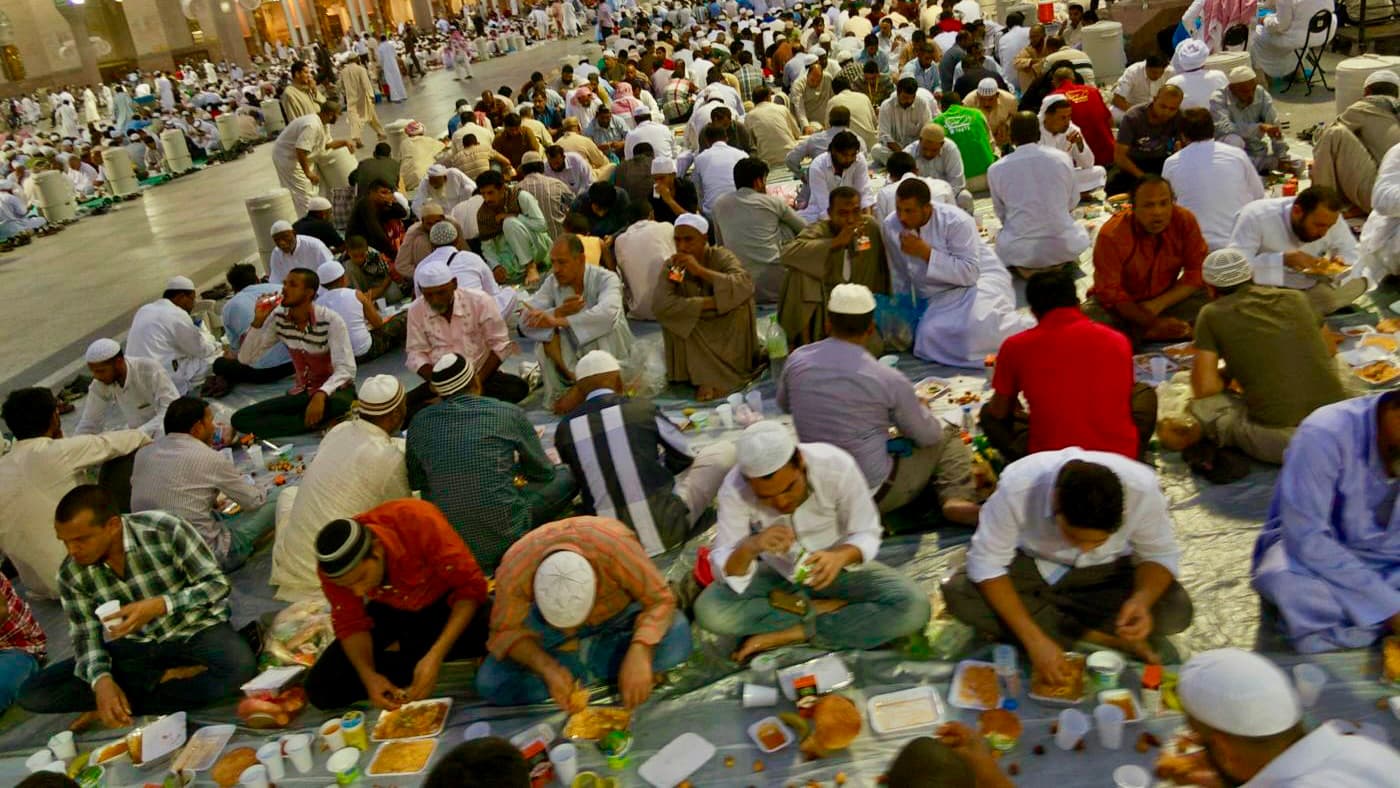
I had two camels and Saudi walking partners. We’d all pause for Ramadan, and I was waiting in a nearby port city called Yanbu for it to pass. [I was] fasting also, even though travelers, as you know, pregnant women and sick people are exempted, but I decided to participate as well. And the Saudi government arranged for me to visit Medina, the second-holiest city in Islam, especially the Haram area, a very sacred area around the Prophet’s Mosque. They made an exception, I’m not Muslim, based on educational purposes, cultural purposes, and it was extraordinary. Basically, they took me there in a car with darkened windows and ushered me into a hotel right across from the mosque. And I was able to witness this amazing breaking of the fast, iftar, with about 60,000 other people after dusk. It was amazing.
So you’re not Muslim, but it was at the site where you joined the fasting during Ramadan. Why was it important for you to do that?
In order to kind of even get at the root of Saudi culture, which, as you know, is extremely religious, I think it was a golden opportunity to see one of the most sacred — it was the ninth month of the lunar calendar in Islam, Ramadan is the holiest. It’s kind of the holy of the holies. And to be able to be a participant, to be a man who’s passing through, right, a storyteller who’s walking through. It took me, I think, close to seven months to walk through the western deserts of Saudi Arabia, the Hejaz, to be there at that time when thousands of people were breaking fast. There were these big plastic, kind of like tablecloths, set out that stretched for many, many hundreds of meters. And you basically sat down, and you broke bread, literally, with the person who was across from you — another stranger, often a pilgrim. There were millions of pilgrims in these holy cities at that time.
Did you? I mean, you must have gotten a sense of the community that that kind of moment creates.
Absolutely. I mean, one of the purposes of Ramadan, as you well know, is to increase the sense of community, spiritual growth, but also connection with others, self-discipline and increasing empathy for people who are less fortunate than you are. I love that month. I love my experience of walking through Saudi Arabia at that time because the world comes alive after dark, right? So people can’t eat during the daytime. You have to stop before dawn and can only finally break your fast after sunset. And that meant communities, villages and towns were awake late into the night. There were street crews doing highway repairs at night when they would normally be doing them during the day. Everybody kind of shifted into a nocturnal mode. It was pretty amazing and quite lovely, actually.
So you said you were in this city of Yambu for a month. Were you not on the move because of Ramadan?
Yeah, it was impossible, because I couldn’t force my Saudi walking partners to walk, you know, 20, 30 or more kilometers to the desert when they’re fasting, right? When they’re not eating. So partly in sympathy, but also because I wanted to participate.
Yeah, I recall when I was living in West Africa during Ramadan, public transportation slowed down because many bus drivers were Muslim. Ramadan concludes with the three-day festival, Eid al-Fitr, the festival of breaking the fast. Fast is obviously broken each night of the month, but this is the big one, to end the month of fasting, and accordingly, food plays a big role. Tell us about the people you ate with and what was on the menu.
I was staying a lot of time in this little village called Yambol Nahal, which is a little bit inland from the Red Sea and Saudi Arabia, kind of the whole country. Actually, an old Pilgrim’s Road community. I got to know the family of a local butcher, and basically, the evenings were a feast almost every night. We had mutton, we had rice. There are certain food practices: You kind of break your fast with a sip of water and a handful of dates, and then you go at it. Yogurt, fresh fruit and the idea of visiting other people’s homes, going and having dinner with others, your neighbors, was one of these magical parts of this particular holy month.
I mean, these days I’m seeing social media with a lot of Muslim influencers who show off their full smorgasbord of what they’re having that evening. Is there any one thing that you remember really fondly?
Well, I was staying with the village butcher, so it was like fresh meat every night, right? So I lucked out if you happen to eat meat. It was, again, there’s a sense of celebration. There’s this kind of sense of quiet celebration, but now at the end of Ramadan, with Eid al-Fitr, it’s just joyous, right? Yeah. During the day, in this little Saudi village along the Hajj Trail to Mecca, people were going around with trays of candy to exchange with each other’s children. It was quite, quite great.
That’s so cool. You’ve walked through several Muslim-majority countries during the first few years of your project, as you explained earlier. How do Eid al-Fitr celebrations you’ve seen in other countries compare to the year you were in Saudi Arabia? Because I imagine cultural differences and factors like conflict, and whether there’s even enough food for a celebration, can change what Eid al-Fitr looks like.
You know, I think it was interesting because from the Middle East, from kind of the homeland, the center where Islam was born, the Hejaz, right? The two holy cities: Medina and Mecca. I moved to Turkey, and I did not experience Ramadan there. But in Central Asia, where there had been 70 or 80 years of Soviet history, and that kind of tradition had been suppressed for generations, it was only starting to come back, right? So it was a bit more private in some of the communities I walked through in the stans, but it was still joyous. It just wasn’t kind of on the scale, with the kind of deep roots that I saw in the Arabian Peninsula.
Parts of this interview have been lightly edited for length and clarity.
Writer and National Geographic Explorer Paul Salopek has embarked on a 24,000-mile storytelling trek across the world called the “Out of Eden Walk.” The National Geographic Society, committed to illuminating and protecting the wonders of our world, has funded Salopek’s project since 2013. Explore the project here. Follow the journey on X at @PaulSalopek, @outofedenwalk.