Public radio’s longest-running daily global news program.
©2025 The World from PRX
PRX is a 501(c)(3) organization recognized by the IRS: #263347402.
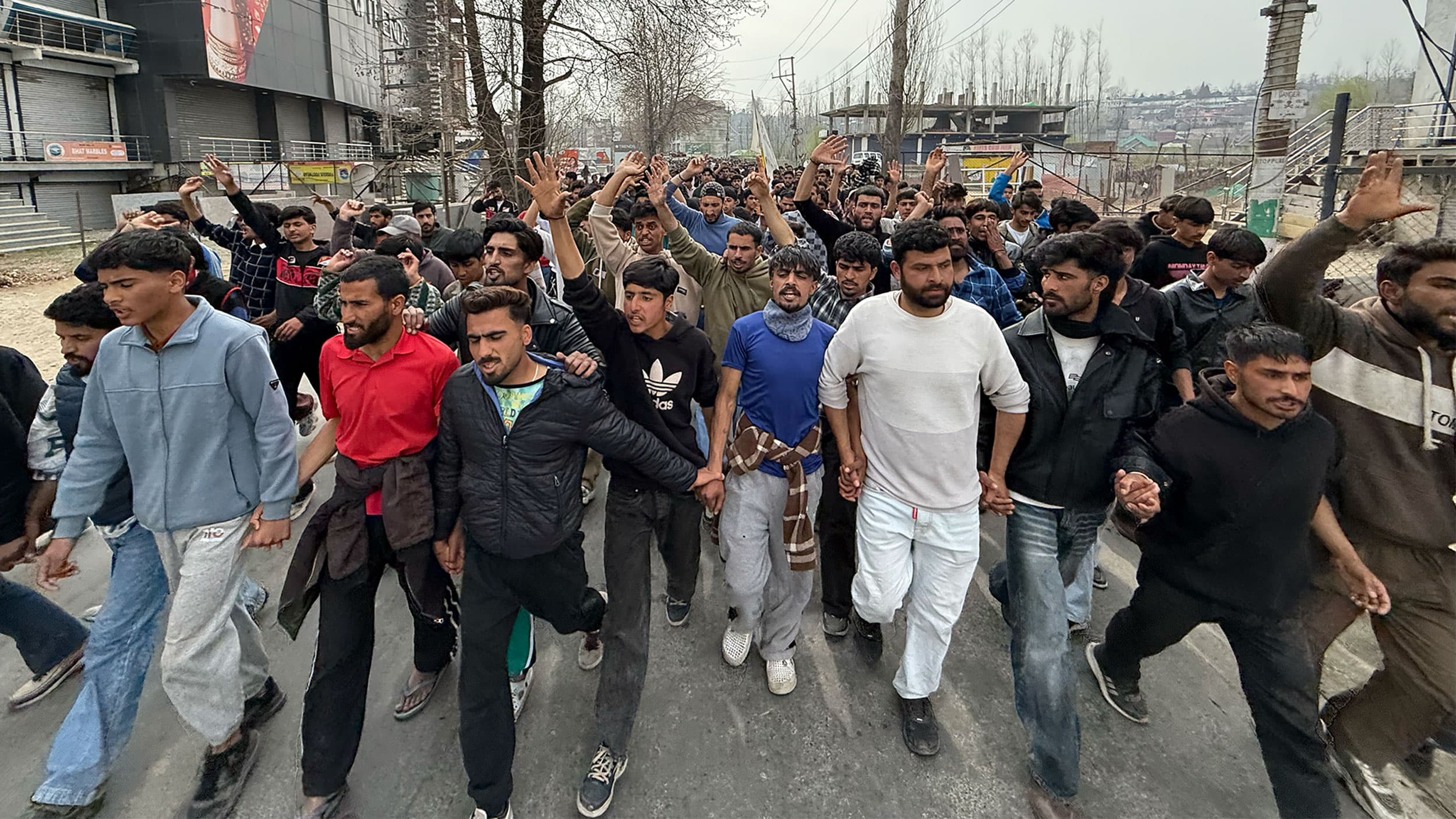
The killing of Iran’s Supreme Leader Ayatollah Ali Khamenei by US-Israeli airstrikes has affected many people, especially Shia Muslims, around the world. In Kashmir, people have taken to the streets to mourn and to protest the assassination.
Kashmiri youth join hands as they march in Budgam to protest the assassination of Iran’s Supreme Leader Ayatollah Ali Khamenei.
Thousands of people gathered in the town of Budgam — an administrative district of Indian-controlled Jammu and Kashmir — a few miles from the capital Srinagar, earlier this month after Friday prayers. They were preparing for a procession to protest the assassination of Iran’s Supreme Leader Ayatollah Ali Khamenei in an airstrike by US and Israeli forces on Feb. 28.
As soon as the prayers concluded, crowds poured into the streets, chanting slogans and reciting lamentations of grief. Men and women marched through the town beating their chests in mourning, while protesters carried placards condemning the killing.

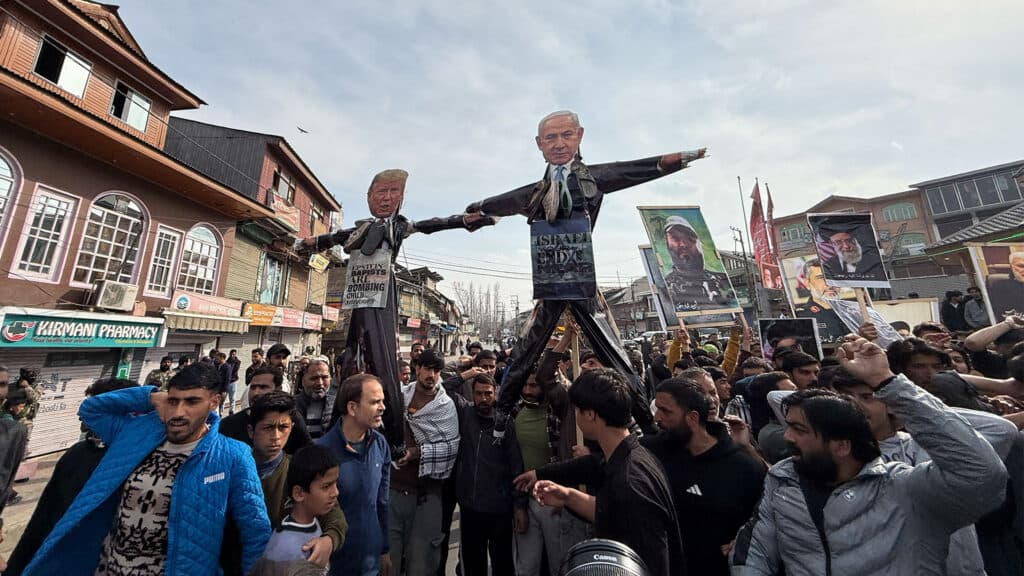
Some demonstrators also carried effigies of Israeli Prime Minister Benjamin Netanyahu and US President Donald Trump. Before setting the effigies on fire, several protesters vented their anger by repeatedly slamming them against the roadside, drawing loud chants from the crowd.
The US-Israeli war with Iran is now in its third week. Iran’s retaliatory strikes on Israel and US assets in Gulf countries have sparked fears of a wider regional conflict. But the implications have reached far beyond the region.
One of the protesters in Budgam, Arif Akhoon, said the Iranian leader held deep religious significance for many Muslims around the world.
“Ayatollah Sayyid Ali Khamenei was not just a political leader of Iran or merely its supreme leader,” Akhoon said. “He was one of the top religious authorities for millions of Shia Muslims and a respected figure for Muslims across the world.”
As the procession moved through Budgam, thousands of women joined the demonstration, following behind the men and reciting lamentations. The march eventually converged at the town’s main center, where protesters gathered briefly before dispersing.

A member of the Indian Parliament from Srinagar and a prominent Shia Muslim leader, Aga Ruhullah Mehdi, also addressed the gathering. He criticized the way authorities handled the situation following Khamenei’s assassination.
“India was never like this. It allowed dissent. People were always allowed to protest, especially when the protest was not directed against the Indian state,” Ruhullah said. “This protest was against a foreign power that carried out an attack on a sovereign country and killed its supreme leader.”
The protest in Budgam was part of a wider outpouring of grief and anger that had spread across parts of Kashmir after news broke of the assassination. Earlier, thousands of people had also marched through the streets of Srinagar in response to the news, with crowds moving toward the city center at Lal Chowk, the historic square that had earlier served as a focal point for political demonstrations in Kashmir.

Authorities later imposed restrictions on protest marches in parts of the city and restrictions on movement in many parts of Kashmir. In one incident, a day after massive protests, security forces stopped a procession on the outskirts of Srinagar and fired tear gas to disperse the crowd.
For many in Kashmir, Khamenei was not viewed merely as an Iranian political leader. Among sections of the region’s Muslim population, particularly within the Shia community, he was regarded as a prominent religious authority and one of the most influential Shia clerics in the world.

The connection between Kashmir and Iran’s leadership dates back decades. In the 1980s, Khamenei visited Kashmir during a trip to India. During the visit, he travelled to several places in the region and also addressed a Friday prayer gathering at the historic Jamia Masjid Srinagar.
Professor Ghulam Ali Gulzar, a scholar who served as secretary of the Muslim Mufakkirin Forum and helped coordinate the arrangements during Khamenei’s visit, recalled the events and his interactions with the Iranian leader. Gulzar also served as one of the translators during Khamenei’s interactions with local audiences.
“He visited several religious scholars and institutions during his stay,” Gulzar recalled. “But what I still remember vividly is that he expressed a wish to see the world-famous Dal Lake and experience the beauty of the place. He requested us to keep the visit discreet for security reasons and asked that we not inform many people, as he did not want a large crowd to accompany him.”

Mourning and remembrance for Khamenei have continued across the region. On the international Al-Quds Day on March 13, traditionally observed on the last Friday of Ramadan, thousands of people in Kashmir who marched in rallies for the liberation of Al-Aqsa Mosque in Jerusalem, also continued their protest of the assassination.
Many participants carried portraits of the late Iranian leader and chanted slogans in support of Iran’s leadership, while others pledged allegiance to the country’s new supreme leader, Khamenei’s son, Mojtaba Khamenei.
Local Shia leaders have also called for a 40-day period of mourning, reflecting the depth of grief among sections of the community. For many of those who have gathered in the streets in recent weeks, the loss of the Iranian cleric has been felt deeply, and the mourning, they say, is unlikely to fade any time soon.