PRX is a 501(c)(3) organization recognized by the IRS: #263347402.
As climate change melts permafrost, landslides are becoming more dangerous
In northern latitudes and high altitudes, permafrost stays frozen year-round, holding mountain summits together. As global temperatures rise, much of it thaws, loosening soil and increasing landslide risk. National Geographic Explorer Paul Salopek is in Alaska, observing a man developing an early warning system for landslides to help communities prepare.
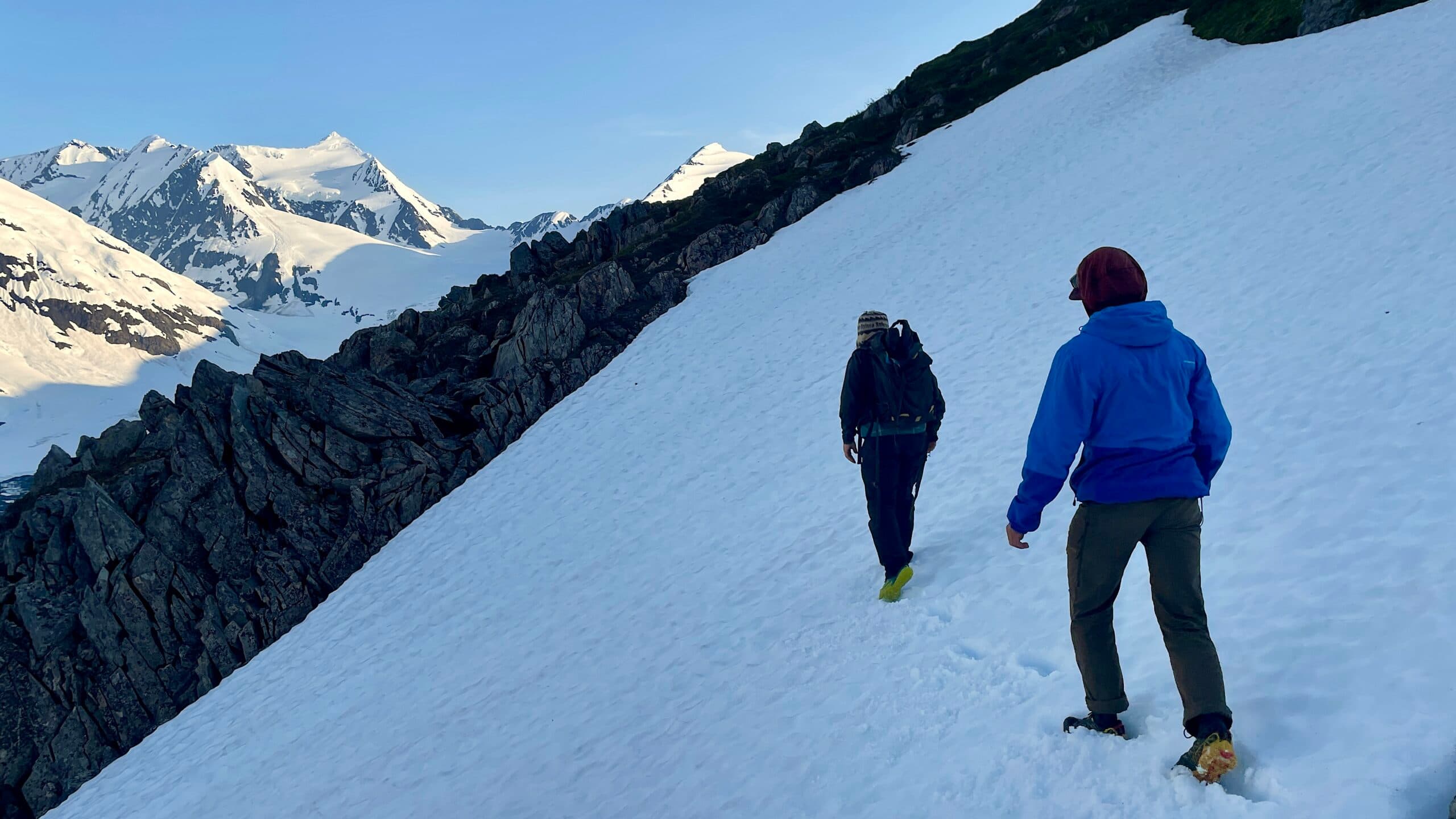
Just another day at the office: Bretwood “Hig” Higman and Krishna Divakarla head up the rim of Portage Glacier, near Anchorage, Alaska, to monitor a massive landslide risk.
Scrambling up the side of a mountain, tracing the path of a receding glacier, is not a part of most people’s average day at the office. But for National Geographic Explorer Paul Salopek, walking across much of the world, it is all in a day’s work.
Salopek recently huffed and puffed his way up a mountain in Alaska to learn about how the permafrost melting under his feet and the glacier receding alongside him will eventually trigger a massive landslide.
He shared more with The World’s Host Carolyn Beeler.
Carolyn Beeler: Paul, when you were not hallucinating from exhaustion, as you write, you were learning about that connection between melting permafrosting glaciers and landslides. What is that connection?
Paul Salopek: Yeah, it was something new to me. It’s something called a geohazard. Mountains, you know, tear themselves down all the time through millions of years of erosion. But apparently, what’s happening is that with the climate crisis — the human-made climate crisis — accelerating around the world, these colder parts of the world, where there are vertical slopes, you know, mountains in the Arctic and in very high altitudes where there’re glaciers, the glaciers are starting to melt, the permafrost is starting to fall. And then you add in increased rains — instead of snowing, it’s raining — so it creates more runoff. And then seismicity, right? Earthquakes … all is leading to an increase in landslides across the world, anywhere where these are these conditions.
Student Krishna Divakarla, geologist Bretwood “Hig” Higman, and guide Phil Norris take in the receding terminus of Portage Glacier, near Anchorage, Alaska. The glacier has receded about four kilometers since the early 1900s, largely because of global warming.Paul Salopek/National Geographic, Out of Eden Walk
You write that these warming trends melt the glacial ice and permafrost, melting the things that once glued mountainsides in place. I thought that was a helpful image. And this is happening all around the world. Can you tell us what this has looked like in recent years in other places?
Yeah, one of the places where it actually has the greatest threat to human life is what scientists call the Third Pole. We all know about the North Pole and the South Pole. But the third is the Himalayas, the highest mountains in the world. They have lots of glaciers, and therefore they’re highly vulnerable to this phenomenon … and they’re relatively highly populated. In the highlands of northern India, for example, hundreds of people every year die from landslides. Now, it’s not always melting glaciers. It could be that snow isn’t falling and you’ve got torrential rain, weakening the sides of mountains, but this is indeed a global phenomenon, and it’s getting worse.
Earth sciences student Krishna Divakarla observes cracks in the mountains hemming Portage Glacier, in Alaska. Some slopes are sliding downwards at the alarming pace of meters per year.Paul Salopek/National Geographic, Out of Eden Walk
I’m recalling that Swiss village that was evacuated, maybe sometime last year, thankfully, prior to a massive landslide there, but that was just a ton of earth moving down the side of that mountain.
Very dramatic. I remember there was footage that appeared online, and basically, it was the same thing, Carolyn. Glaciers are rivers of ice, and they’re hemmed in by peaks, right? By mountains. They’re basically flowing down the sides of very high peaks and into valleys. And when those mountainsides — which have sometimes been frozen for thousands of years since the last glaciation — melt, they actually start shearing off and collapsing. What happened in Switzerland is what occurred. A mountain crumbled on top of an already weakened glacier, and it basically collapsed the glacier, which then went rumbling down and obliterated a town, a village.
So, this brings us to your latest dispatch. You hiked up this mountain along the edge of a receding glacier with a geologist studying it. Let’s start by having you take us there. What was that hike?
To get to the site, I was walking with a geologist named Bretwood Higman to the site where he and his colleague implant motion sensors to start prototyping an early warning system. We had to paddle about six kilometers, something like four miles across a glacial lake that was very choppy, blown by icy winds blowing off this glacier. We had to stash our extra gear on a cliffside with ropes to keep it out of the reach of grizzly bears. And then we had to climb almost a vertical kilometer up to the sides of this very steep scarp. Carrying heavy loads of scientific equipment in our backpacks. I was not just huffing and puffing; I thought I was gonna be murdered by gravity, and this geologist, Higman, was just bouncing up there like a doll sheep.
Yeah, you paint him as quite the character, nimble as an acrobat, I think you say. Could you tell us more about the research he’s doing? You say embedding these sensors up high in the mountains, what could they eventually tell us about the seismic activity in those mountains? Does it ramp up before a landslide in a predictable way?
Basically, the way it was explained to me is that you can see tremors increase. Their frequency starts to increase. And that doesn’t tell you exactly when it may happen. And Higman, he was very plain, he said, “Paul, some of these things have been hanging in a kind of suspended animation for centuries, and others kind of surprise us. They happen behind our backs, and we don’t have it down yet. The science of predicting it is complicated.” Another way, other than motion sensors, is subsonic sound, which is kind of cool. Some scientists have implanted listening devices into the sides of mountains, which emit sounds that the human ear can’t hear, increasing in frequency up until slightly before the mountain collapses. Then it goes kind of dead silent for this ominous period before the mountain slides down. So, they’re trying different technologies to give human beings a little warning that a catastrophe is about to happen.
It feels rather poetic to actually listen to the mountains to better understand this, listening to see what nature has to tell us.
Absolutely. I think we’re just going to have to become more alert as the world shifts under our feet, in this case, literally. As I mentioned in my story, we camped out on top of the ridge that was cracking, and there’s these huge cracks. You can see the roots of plants being stretched taut across these cracks. That’s how quickly it’s moving. And, we slept in sleeping bags on top of the tundra. And I just remember putting my ear to that, even though I knew I couldn’t listen. It was like putting my ear to the chest of a patient who had some terminal illness.
Geologist Bretwood Higman displays a predictive computer model of the likely consequences of a landslide into Portage Lake, near Anchorage, Alaska. The shockwave from a collapsing mountainside would send a tsunami of water across the glacial lake, engulfing a visitors’ center, a highway, and the undersea cabling that carries about half of the state’s internet capacity.Paul Salopek/National Geographic, Out of Eden Walk
Has your thinking about climate change changed at all since you saw those things up close?
I’ve been seeing evidence of pretty dramatic climate change for the last 13 years on my walking project. Everything from places getting drier to places getting wetter. I think climate change is pretty much everywhere. It’s global and indisputable. So, this was just the latest evidence in a dramatic way, kind of with a bang, that this is something we’re going to have to start really getting used to in our lifetimes.
Parts of this interview have been lightly edited for length and clarity.
Writer and National Geographic Explorer Paul Salopek has embarked on a 24,000-mile storytelling trek across the world called the “Out of Eden Walk.” The National Geographic Society, committed to illuminating and protecting the wonders of our world, has funded Salopek’s project since 2013. Explore the project here. Follow the journey on X at @PaulSalopek, @outofedenwalk.