Public radio’s longest-running daily global news program.
©2025 The World from PRX
PRX is a 501(c)(3) organization recognized by the IRS: #263347402.
Colombia is vying for a place in the global race to produce renewable energy. One desert region on its Caribbean coast is crucial for those energy goals: La Guajira. And efforts are ramping up quickly to expand the region’s green energy potential, with plans to drastically increase the number of wind farms planted on the desert soil over the next decade.
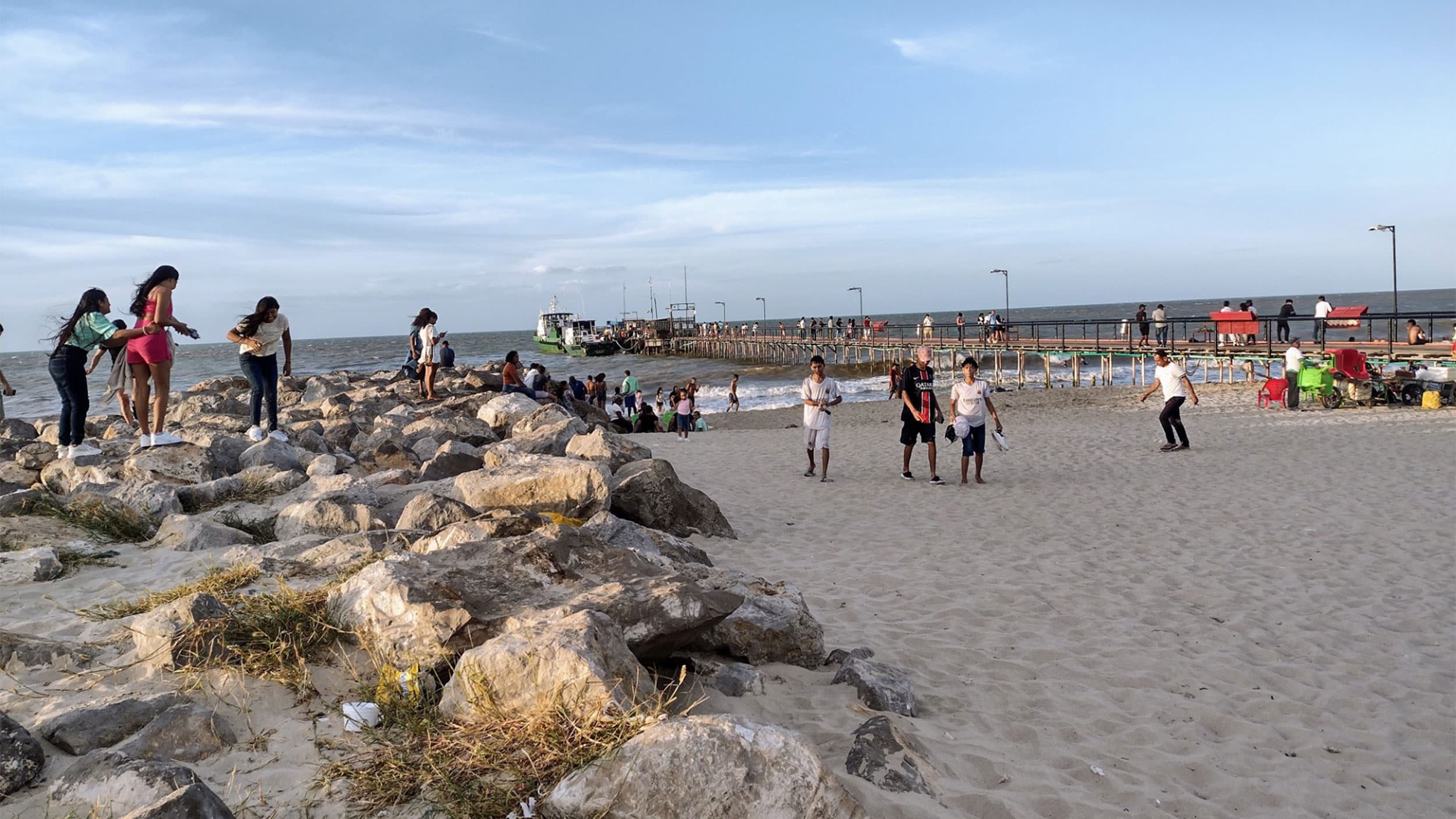
People stroll along a beach in Riohacha, Colombia, Nov. 23, 2025. Energy companies are also eyeing the potential for offshore wind farms in the La Guajira region of Colombia.
Between high wind speeds and lots of sunlight, La Guajira — a desert region along Colombia’s Caribbean coast — is considered one of the world’s most promising locations for wind and solar energy projects. Dozens of renewable energy projects are at various stages of development in the region, and at least 40 wind farms are projected to begin operations within the next decade. Currently, only one 10-turbine wind farm is operating.
Felipe Gonzalez Penagos, the La Guajira regional manager for Colombia’s state-owned oil and gas company Ecopetrol, said the area holds significant potential for cleaner energy sources.
“When you take La Guajira and you compare it with the world,” Penagos said in Spanish, “La Guajira is ‘world-class.’ It’s very competitive.”

But in that remote part of Colombia, nearly a day’s drive from the capital Bogotá, harnessing green energy requires more than capturing strong winds and sun. La Guajira is one of the poorest parts of the country. It’s also home to Colombia’s largest Indigenous group, the Wayuu.
The region has long struggled with armed groups, inadequate infrastructure and little government help. Just under half of the population there doesn’t have access to electricity, and a majority of rural residents don’t have safe drinking water.
Companies and government entities are required to get approval from local Indigenous groups before moving forward with projects, but the process has been anything but smooth. Protests, roadblocks and other hurdles have led to many paused or canceled renewable energy projects over the years, prompting some companies to take their business elsewhere.
Meanwhile, the Colombian government has outlined plans to achieve net-zero emissions from greenhouse gases by 2050. In 2023, President Gustavo Petro announced that no new exploration contracts for coal, gas or oil would be signed. Colombia has long been a major producer of both coal and oil in South America.
Petro has also promised to pursue a “just transition” away from fossil fuels, focused so far on dialogue with Indigenous communities and training opportunities around renewable energy.
Joanna Barney, a lead researcher on climate issues with the Colombian think tank Indepaz, said a sudden interest in understanding customs and promoting conversation with the Wayuu may suggest more than just a bent toward justice on the part of the Colombian government.
“The relationship between the Wayuu and the government is very complicated,” Barney said. “It’s a region left behind by the state, but now, like colonizers, they want to understand it better to help corporations enter. It’s a little contradictory.”
Colombia’s state-owned oil and gas company, Ecopetrol, has grand plans for green energy projects in La Guajira. First up: Windpeshi. With 41 wind turbines spread across the desert floor, the proposed wind farm is expected to generate up to 205 megawatts of electricity — over 10 times the capacity of the only project currently generating wind energy in La Guajira. Officials say it would also reduce millions of tons of carbon dioxide emissions.
But this isn’t the first time an energy company has dreamed of a future for Windpeshi. The project was previously under construction by the Italian-owned energy company Enel. After years of stop-and-go development, Enel permanently halted work on the site in 2023 after protests by Indigenous communities shut the project down. Then, Ecopetrol took over the wind farm project last July.

Getting Indigenous Wayuu communities on board for projects like this one hasn’t been easy. Wayuu cultural values and connections to the land have sometimes been at odds with companies’ natural resource needs. In some cases, corporations have not taken adequate measures to gather consent.
A history of insufficient government investment and resource-based exploitation have resulted in generally low levels of trust. La Guajira is home to Cerrejón, the largest open pit coal mine in Latin America. The mine has long been criticized for human rights and environmental violations, like contaminating water supplies and forcibly displacing residents.
Barney said energy companies arrive promising resources and infrastructure that the Colombian government historically has failed to provide. It creates a power imbalance.
“It’s very difficult to pursue a fair negotiation with Indigenous communities because they’re negotiating with misery,” Barney said.
Griselda María Polanco Jusayu, a Wayuu lawyer who lives in the community of Petsuapa near the Windpeshi project site, participated in protests against Windpeshi a few years ago. She’s cautiously optimistic that Ecopetrol might do it right this time. She said that, so far, Ecopetrol officials have demonstrated a clear interest in improving life for locals through things like health care, water and infrastructure.
“We’re just getting started, but we’re hoping that it will go well for us with Ecopetrol,” she said. “This energy transition could bring us a lot of social development — but it will also bring a lot of risks.”

Ecopetrol’s track record is far from clean. A report from the Environmental Investigation Agency released last spring found the oil and gas company had a history of severe environmental contamination and human rights violations, including targeting activists. Colombia is the most dangerous country in the world for environmental activists, with Indigenous activists disproportionately targeted, according to Global Witness. Ecopetrol is the largest corporation in Colombia.
Abraham Jayariyu, a legal representative for an association of Wayuu traditional authorities in La Guajira, said Indigenous communities in his region have long watched energy companies come in without showing respect for the Wayuu. He said he’ll believe it’s a “just transition” when he sees it.
“Our land is very sacred to us,” he explained. “It’s unjust for a company to come in, extract natural resources on our land and also leave poverty and destitution. There’s no justice in that. We can only talk about justice when there are also clear signs of development for the Wayuu.”

Some hope Ecopetrol’s ties to the Colombian government will make the energy company more attentive to the needs of La Guajira’s residents when developing future renewable energy projects. But Jayariyu isn’t totally convinced.
“So, Ecopetrol is part of the state,” Jayariyu said. “Well, the state, more than any other, has to set an example for future companies that come on to our land, so they know who we are, show us respect and understand the conditions under which they’ll be allowed here.”
Still, many locals in La Guajira hope renewable energy projects will also bring jobs and new infrastructure to their communities. Yabri Gonzalez, the leader of a Wayuu community near the Windpeshi project site, said that Windpeshi can’t come soon enough. Children in her community suffer from malnutrition and a lack of access to potable water. Some locals have been forced to seek work elsewhere and leave behind families.
Windpeshi could make a big difference in the economic opportunities available and resources invested there.
“We, the Wayuu, had been practically abandoned by the state,” Gonzalez said. “This project gives us hope for a better life.”

Penagos of Ecopetrol said officials expect to restart construction on Windpeshi in 2026 and render the wind farm operational by 2028. But this isn’t just about one wind project.
“Ecopetrol has a long-term vision for La Guajira. Windpeshi could be the tip of the spear,” Penagos said.
But it all hinges on one major hurdle: “If we can break through and manage to develop relationships with the communities, and they feel that we respect their customs and ways of life,” Penagos said.
Jusayu, the Wayuu lawyer, said that won’t necessarily be an easy feat.
“To win that trust back,” she said, “it’ll take a lot of hard work.”