Public radio’s longest-running daily global news program.
©2025 The World from PRX
PRX is a 501(c)(3) organization recognized by the IRS: #263347402.
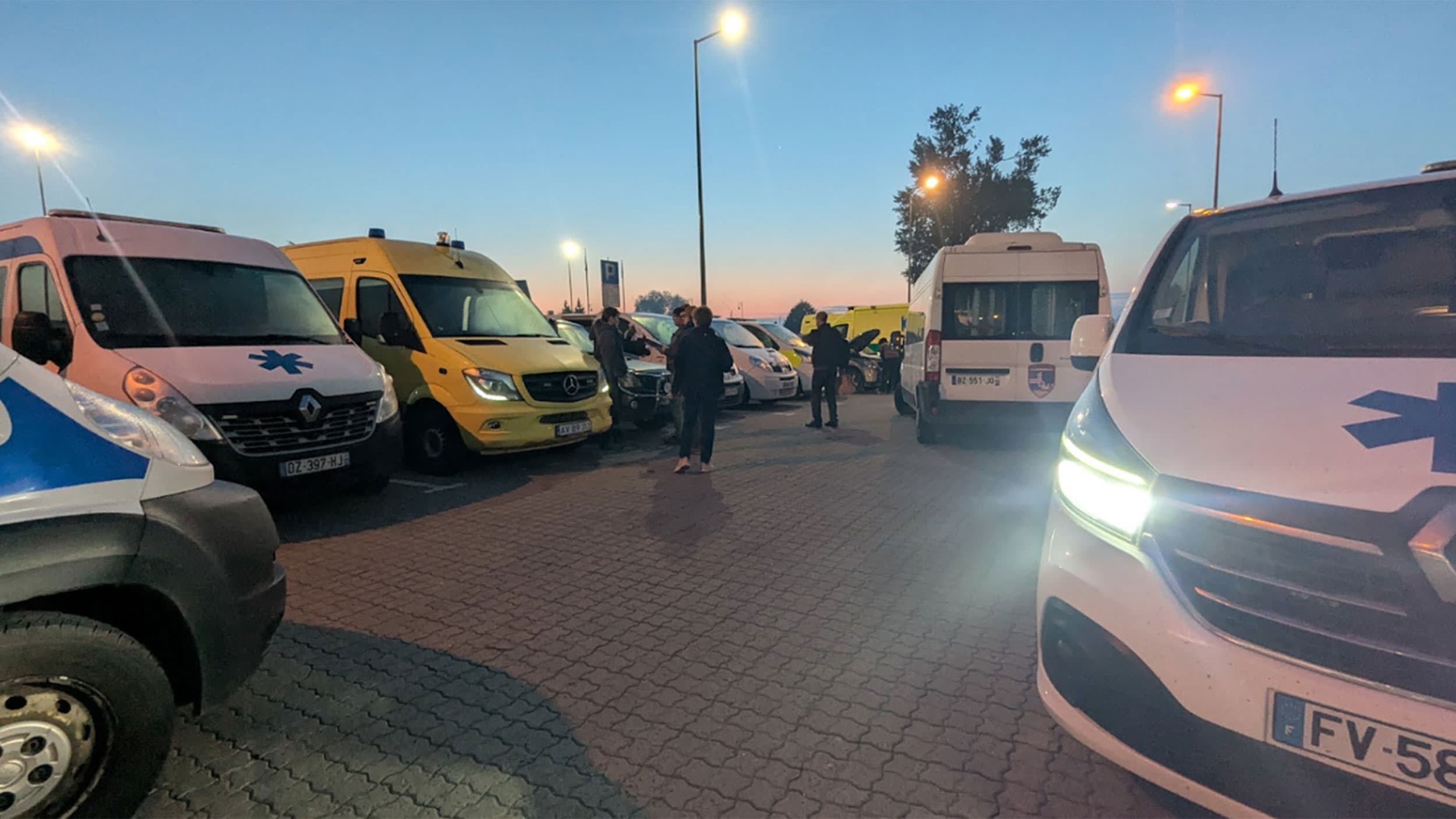
A Ukrainian mother and volunteer joins a convoy of donated ambulances bound for the front lines in Ukraine — part of a civilian-led supply chain supporting the war effort.
Ambulances in Rjezwaw, Poland, await the final leg of the journey into Ukraine.
At 6 a.m., outside a hotel parking lot in Katowice, Poland, a line of ambulances warmed up in the cold morning air. Forty-three-year-old Oksana Berleva hopped into a mustard yellow Mercedes Sprinter ambulance.
“I came the day before yesterday on a bus,” Berleva said. “I spent 22 hours [traveling] from [the Ukrainian capital] Kyiv to Katowice.”

It normally takes half that long, but on Oct. 5 a barrage of missiles and drones struck Lviv — halfway between the two cities — one of the largest attacks there since the Ukraine war started.
Berleva and dozens of passengers waited on a bus outside the city while the bombardment raged.
“We lost hours. Just standing,” she said.
She eventually crossed the border into Poland, where she joined a group of volunteers delivering ambulances to Ukraine. The mission was organized by Ukraine Focus, an American NGO that donates ambulances to Ukraine’s Territorial Defense Forces, the civilian volunteer brigade that formed at the start of the war.
She’s part of a network of civilians volunteering and pitching in to support Ukraine’s war effort.

Berleva’s own introduction to the war’s improvisational defense effort began outside her home in Kyiv. One day she and her neighbors were handing out coffee to soldiers, and then they were loading magazines into Kalashnikovs the next.
“In every village, in every house, it was some guy or veteran, or just a colonel or somebody who had experience of war, and he said we just meet here,” Berleva said. She learned the ropes quickly.
A lot of Ukraine’s defense operates this way, not through official government channels, but through people like Berleva — regular citizens on Telegram channels — who raise money and plan what to do.
Berleva eventually found her place helping her country as an ambulance driver.
She rarely has much of a heads-up when she’s needed, being called up at a moment’s notice. It helps that she travels light — with just a backpack and a change of clothes, some water, snacks, her phone charger and cigarettes.
On bigger missions, the logistics are a cross-continental relay. Some volunteers fly across the world to drive across a continent. On this trip, Berleva joined a convoy that originated in northeastern France, at the garage of Lucas Wojcik, a Franco-Polish ambulance dealer, who helps Ukraine Focus source vehicles.
Wojcik’s business used to focus on supplying used ambulances to movie sets and nursing homes. But now, about a third of his time goes to sourcing vehicles for the war effort. Usually, it is individuals buying two or three ambulances to donate. But a few times a year, he orchestrates a larger initiative, like the one that Berleva joined, to supply dozens of vehicles. Wojcik calls them “life-saving machines.”
Ukraine Focus is one of a handful of international aid groups supplying these emergency vehicles to Ukraine. Its volunteers drive used medical vehicles across Europe and into Ukraine. The group says ambulances are among the most urgently needed items on the front lines.

“More than 40% of what the army uses now comes from civil society,” said Oleksandr Reshetkov, who coordinates logistics for Ukraine Focus in Kyiv. Everything from anti-drone systems to drones, vehicles and helmets are supplied by “ordinary people abroad, fundraisers, not governments.”
On Berleva’s 19th mission, she was one of just two Ukrainian drivers who participated in a convoy of more than two dozen ambulances heading into Ukraine. Most of the volunteers were Americans — veterans, former Peace Corps Volunteers and former USAID staff. Some were even from former Soviet bloc countries like Lithuania. Others had no personal or professional connection to Ukraine but were nonetheless moved to help.

Most of the missions Berleva has participated in have been much smaller. She said usually when she comes into the EU to collect vehicles, it’s women making the trek.
“Some men are in the war, other men are hiding from the war, and not many guys can pass the border from Ukraine. They are not allowed. It’s very difficult to get permission to leave Ukraine,” Berleva explained.
She’ll travel sometimes for days just to turn around and drive back in the same direction.
“We take one small car of women, four or five drivers, [and] go to another country,” she explained. They will then each pick up their own vehicles to drive back, usually SUVs or 4-wheel drive trucks.
“Sometimes we stop for a couple of hours in the parking [lot] just to have a little sleep, but without hotels, without normal food, without anything,” Berleva said, “because these women who drive, these volunteers, they don’t have time [to spend] many days [on these trips] because they are working, and maybe they don´t want to spend money for the hotels.”
It’s often a gamble what condition the vehicles will be in — hopefully good enough to make the long trek back to Ukraine, and then to the east, where they must withstand roads pockmarked with rubble and potholes. Many last only months, battered by mine-scarred roads and hunted by drones. Over 70% of the ambulances donated through Ukraine Focus have since been destroyed. During the time they are in the field though, Ukraine Focus says each ambulance may transport up to a dozen people a week.

In Ukraine, volunteer networks have become a parallel foreign policy and supply chain, filling gaps in aid and building direct links to battlefield units.
Their contribution is small in absolute dollars but outsized in impact. Unconstrained by official politics, this aid often arrives more quickly and directly to where the need is, forming an auxiliary logistical architecture that not only supplies equipment but also cultivates relationships with commanders.
Civilian support has existed in most wars, but experts say the availability of communications and digital connectivity — fundraising platforms, messaging apps and open-source technology — means that the war in Ukraine is pushing the degree to which it plays a role on the battlefield.
“Northwestern University has an alumni association, and it’s got friendly people that give it money,” said William Reno, a political science professor at the university. “I think that a lot of units in Ukraine’s military, they’re kind of like that.”
For soldiers, what matters is effectiveness. And for Ukraine’s military, partnering with outside NGOs is one way military units can survive.

Before the war, Berleva owned a coffee shop in Kyiv, which she’s had to close down. “Because our life — we don’t know stability, we do not know what it will be,” she explained. “And I should be ready to go away with [my] children from danger.”
She’s now a manager for a cosmetics distribution company. She works remotely, which means she can disappear for a few days. Meanwhile, her husband is on the front lines in eastern Ukraine.
Berleva said she likes the drives because they give her a break, a few days away from the war. She listens to music, podcasts, her favorite band: Kozak System. Sometimes she just walks around a mall.
“I am not a shopaholic in my real life. I don’t go to shops and everything. But here, when I come into the big mall and see that there are no alarms, the mall will not close now, I just walk,” Berleva said.
She said that before the war, she and her husband had a dream of traveling the world in a camper van. They once had a Volkswagen with a bed in the back.
“We had some trips on our sea in Odessa, in the Carpathians, in Ukraine. Van life, yes?” Berleva said, smiling. Maybe one day.
As the convoy neared the Ukrainian border, drivers pulled into a rest area to regroup. Berleva sat in the driver’s seat and looked at the line of vehicles — white, yellow, patched with decals and humming in the autumn air.
“The easiest way is to be a refugee from Ukraine, just to leave the country,” Bereleva said. “But maybe those who are in Ukraine now, they write the history of this land.”
So, to that end, she drives, transporting hope, one vehicle at a time.
Editor’s note: This story was updated to reflect the diverse range of volunteers better.