PRX is a 501(c)(3) organization recognized by the IRS: #263347402.
Calls during UNGA to investigate thousands of Ukrainian children being forcibly transferred to Russia
Canada organized a summit at this year’s UN General Assembly to address the thousands of Ukrainian children who have been forcibly transferred to Russia over the past several years. The World’s Shirin Jaafari attended the session at the UN headquarters in New York and discussed the details with Host Marco Werman.
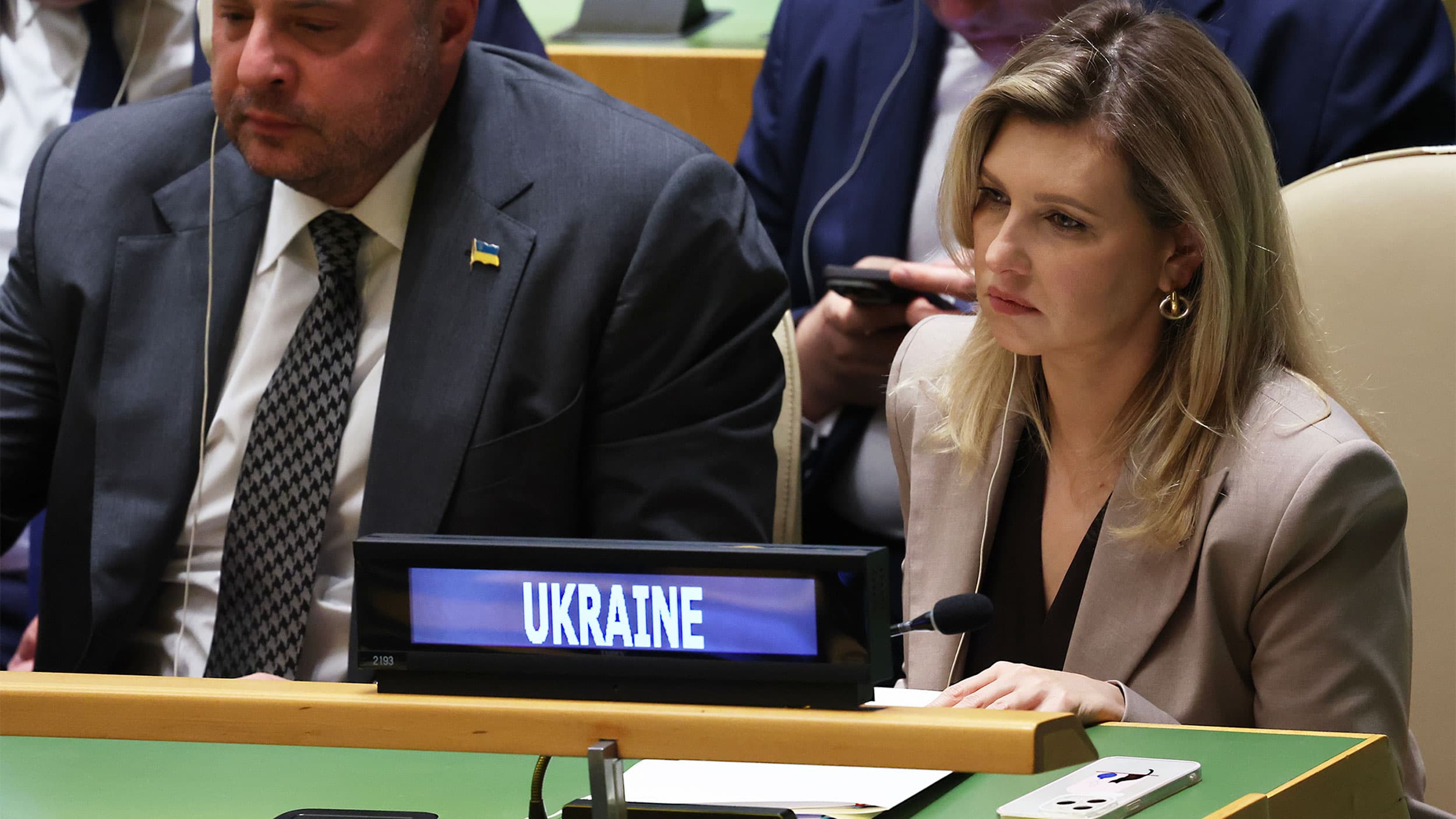
Ukraine’s First Lady Olena Zelenska attends the 80th session of the United Nations General Assembly at the UN headquarters in New York, Sept. 24, 2025.
Heather Khalifa/AP
Two major conflicts were top of mind at the United Nations General Assembly this year: the wars in Gaza and in Ukraine.
US President Donald Trump addressed delegates at the UN headquarters in New York and said he had thought Ukraine would be the easiest war to end but that Russia’s President Vladimir Putin has proven to be recalcitrant. Trump also mocked Putin’s management of the war.
“It was supposed to be just a quick little skirmish. It’s not making Russia look good. It’s making them look bad,” Trump said. “No matter what happens, from here on out, this was something that should have taken a matter of days, certainly less than a week, and they’ve been fighting for three and a half years.”
A short time later, Ukrainian President Volodymyr Zelenskyy took part in a summit at the UN organized by Canada. Canadian Prime Minister Mark Carney laid out the need for the conference.
“Putin has stolen Ukrainian children,” Carney said. “Thousands of children have been abducted by Russia. Russia has repeatedly targeted the most vulnerable groups of children, including orphans, children with disabilities, children from poor families.”
Children from Donetsk region, the site of heavy battles with the Russian troops, wait to evacuate at a railway station in Lozova, Kharkiv region, Ukraine, Sept. 26, 2025.Andrii Marienko/AP
The World’s Shirin Jaafari was at that conference in New York, and she joined Host Marco Werman to discuss more.
Marco Werman: Shirin, what was the goal of this session at the UN?
Shirin Jaafari: Well, the reason Canada organized this event, Marco, was because it wants to raise attention to the missing children of Ukraine, specifically children who have been taken by Russia.
The Ukrainian government estimates that about 20,000 of them have been forcibly transferred since 2022, but experts say that that’s an undercount, and the figure is more like 35,000. President Zelenskyy was his usual self, wearing his military-themed outfit, that’s what he’s been wearing since the beginning of the war, and he had a clear message for the audience: “The crime must be stopped. The felons must be held accountable. Ukrainian children must be brought home.”
In addition to Zelenskyy and Carney, both of the First Ladies of Ukraine and Canada spoke, as well. And they drew on the themes of motherhood and the fact that the safety and well-being of children must be a priority for everybody across the world. They both gave examples of children whose lives were turned upside down because of having been abducted by Russia. Olena Zelenska, Ukraine’s First Lady, said: “If one child were abducted, we would be outraged and demand justice. But what if an entire state, using its institutions in the army, abducts not only one but thousands of children?”
And Marco, you could tell that this is a very emotional topic for both of these women.
Yeah, that’s evident. Shirin, how do these children end up in Russia or Russian-controlled areas?
There are different ways that they end up there. They’re either taken by force when Russian soldiers take over their towns and cities and their parents are killed in attacks. And then some of them are sent by their families, teachers or local community leaders but they’re sent for what is meant to be a temporary period of time, like for a summer camp, but then Russia doesn’t allow them to return. And then, some of these children are in state institutions, like orphanages, and they are basically scooped up and taken away when their cities or towns are taken over by Russian forces.
Awful situation and honestly one that we don’t hear nearly enough about. So, this has been going on for a while, as you said, Shirin. What is the goal of this conference at the UN?
So, the goal is to draw attention and to get the help of powerful leaders, like President Trump, to get these children back home. Now, I have to emphasize that abducting children and re-educating them, which is what Russia is doing, is against international law.
And in fact, in March 2023, the International Criminal Court issued arrest warrants for Putin and Russia’s commissioner for children’s rights, Maria Lvova-Belova, for alleged war crimes. So, that was the first step toward accountability. The session at the United Nations came just a few days after a new report by war crimes investigators revealed that the problem of abduction of these children is much worse than what we previously knew about.
An exterior view of the International Criminal Court at The Hague in the Netherlands, Dec. 6, 2022.Peter Dejong/AP/File photo
Yeah, how so, Shirin? What does the report say?
So, these researchers initially thought that there are 115 sites in Russia where Ukrainian children are held, but then they found that, in fact, the number is 210. Nathaniel Raymond heads the humanitarian research lab at the Yale School of Public Health, and he was involved in the research.
“This case is the single largest kidnapping of children since World War II in war,” Raymond said.
Raymond told The World that there are different types of “camps” for these children in Russia. There are ones where the focus is on re-education, meaning that children are not allowed to speak Ukrainian and they’re educated in Russian and they have to speak Russian. Otherwise, he said that in some cases, they are given solitary confinement as punishment if they do that. He said that the youngest child that he knows about that is in these programs was just four months old, Marco, when he was captured in Ukraine, and then some of these children end up in camps that train them for military purposes.
“That can include literal training and combat tactics. Some were sent to a paratrooper jump school. Others, we can even see from space, are at locations with shooting ranges, while others are sent to what’s called cadet corps programs.”
These are really young children, and you can understand why this is so concerning for researchers and war crimes investigators.
Yeah, really shocking. So, from solitary confinement to military training, how were Nathaniel Raymond and the other researchers at Yale able to learn this? Because obviously they can’t just go to these camps and see what’s going on, right?
Yeah, exactly, that is one of the challenges when it comes to researching and verifying the facts of this story, that they can’t access these sites, but they use satellite images and Russian government documents to verify and find out about these sites. They also used Russian officials’ social media posts about this, and they verified the location of these camps with five other independent sources, according to Raymond.
Is there any evidence that the children who get military training actually end up on the battlefield?
Raymond said that, so far, they don’t have concrete evidence that that is the case. They don’t have any bodies of children from the battlefield or their tags or any sort of reliable evidence that they are being sent to front lines. But he said what we can tell from these satellite images and all of the information they’ve been able to gather is that the type of training that they’re being given is the type that you would give soldiers and you would send them to front lines. So, there is a great possibility that they are, in fact, being sent or planned to be sent to front lines.
So, now that the world knows about these sites, Shirin, what happens now?
Well, President Volodymyr Zelenskyy said that he wants to see more accountability, that the issue of these children cannot be forgotten and set aside. But researchers like Raymond face challenges. And one of them, Marco, is that the United States has imposed sanctions on individuals at the International Criminal Court and that has complicated the work of these war crimes researchers.
“There’s been extreme confusion about whether the sanctions against the ICC puts American organizations at risk for sharing information on Ukraine, Sudan and other cases not related to Israel-Palestine,” Raymond added.
And Raymond said that his team decided to list all of these locations in their report publicly so that they could provide this information quickly and effectively to prosecutors at the ICC without risking violating US sanctions.
This interview has been lightly edited and condensed for clarity.