Public radio’s longest-running daily global news program.
©2025 The World from PRX
PRX is a 501(c)(3) organization recognized by the IRS: #263347402.

The Draw of Pines gained some attention this summer as fires raged through forests nearby — but sparing the Urbión forest. The World’s Gerry Hadden looks at an ancient Spanish tradition that’s taken care of forests but is now in danger of disappearing.
A view of Urbión Model Forest in Soria, Spain.
The Urbión forest goes on and on … and on, covering nearly 500,000 acres. It’s as remote and rugged as it gets in Spain, but the forest itself looks pretty clean.
Helping to keep it that way is a logger named Oscar Hernandez, a grey-bearded lumberjack, who said he’s been at this his whole life, like his dad, he said, and his grandfather, a hundred years ago.
“My grandfather used oxen to drag his draw of pines down the mountain,” he told The World. The draw, or allotment, of trees in the forest pre-dates his grandfather by several generations. It was established by royal decree beginning in the 13th century to encourage people to move back closer to abandoned forests. In exchange for resettling them, families were allowed to exploit trees and other forest materials for personal profit.

“In my grandfather’s day, each family had rights to say, 5 or 10 trees,” said Hernandez. The landowners would mark all the trees that needed felling with numbers, and then families would pick the numbers randomly. After that, it was up to each family to go out and fill their allotment, to sell them.”
Five or 10 trees might not sound like a lot of wood, but these are towering Scotch pines, reaching to 100 feet or more. They’re used in construction and for furniture. They were traditionally worth a great deal of money. So, the “Draw of Pines” creates a classic win-win, said local Forestry engineer Pedro Medrano. The forest is taken care of, and so are the people.
“It generates an entire economy around felling, trimming, transporting and milling these trees,” Medrano said. “Small cooperatives sprang up, along with specialized guilds. There are those who focus solely on collecting the cut branches for fuel.”
The Draw of Pines gained some fame this summer, as fires raged through forests nearby, but not the Urbión forest. Newspapers held up the Draw as a model for fire prevention. And that actually rankles Medrano, who also runs the Soria Forestry Association, representing forest owners.
“When you read in the local press that the Draw of Pines is a vaccine, or some sort of superhero’s shield against big fires,” he said, “that’s just plain false.”

It was true, Medrano said, but the way things have been going in recent decades, the Draw is in danger of becoming irrelevant for several reasons. First, he said, the Draw was designed for a pre-industrial agrarian world.
“The society back then was optimal,” Medrano said. “But today, not everyone works in and lives off the forest.”
Today, in the 36 small towns that abut the forest, the working population includes barbers, bar owners, car mechanics and IT specialists. People with no time to cut trees. Thus, vast swaths of the forest are becoming overgrown, creating a fire hazard. The logger Oscar Hernandez — one of his five brothers who still works in the woods — agrees.
“All the young people have left,” Hernandez said. “They’re not interested in this life of toil. My own son, who’s 18, doesn’t want to do this. He’s in college studying IT. I don’t want him following in my footsteps either.”
As a landowner, Hernandez receives money through the Draw of Pines. But each year it’s less, adding another disincentive to forestry work. One reason for the dwindling draw is that the price of wood has not kept up with the cost of labor over the last few decades. So, extracting the lumber costs more, and it fetches less at the market.
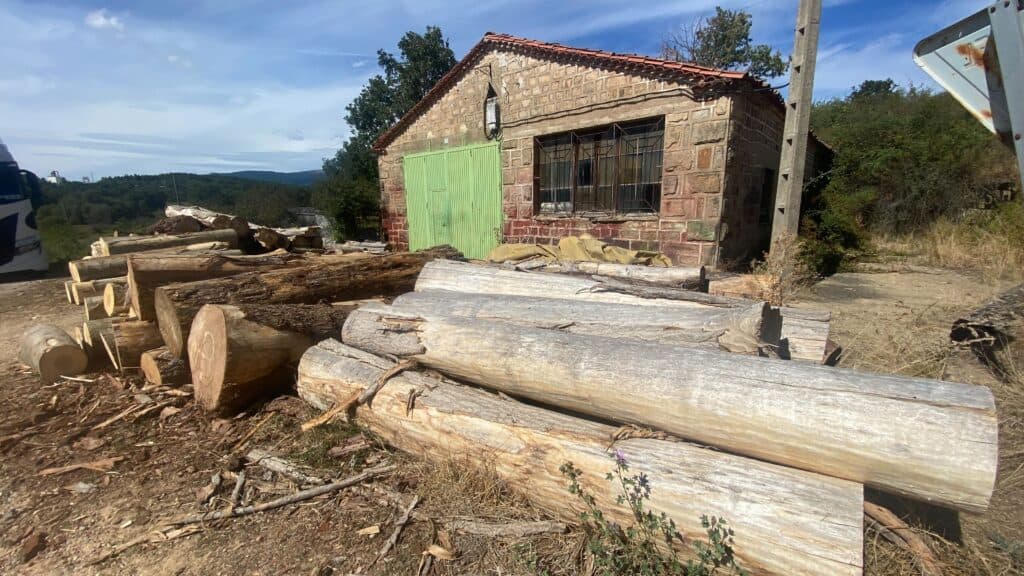
Today, many people limit their forest work to collecting a few fallen branches for firewood.
Mario Sori was in his yard in the town of Covaleda one day, cutting up what he’d collected. He said the forest used to be an attractive source of income.
“My dad used to earn the same from the trees he got via the Draw of Pines as what he’d make working an entire year in a factory,” Sori said.
The substantial amount of money and its growing popularity made it hardly surprising that some years back, the Draw caught the attention of Spain’s tax authorities, and now earnings from the Draw are getting dinged at the local, regional and federal levels.
“One of the only few viable forestry businesses left around here is the sawmill down the road,” Sori told The World. The owner of the sawmill is Carlos Jimeno. He said business is, in fact, good … but that’s because there are no competitors left. Covaleda’s several other mills have all closed up shop.
“The towns around here are in decline,” Jimeno said, shaking his head. The population here has dropped from 2,500 to 1,000. And I can’t find anyone to work, he added. I just hired a newly arrived immigrant from Mali, because there’s no one else.”
To keep people from moving away, Pedro Medrano said the local forestry sector needs reforms and new incentives.

“We need to simplify all the paperwork,” said Medrano. “And to subsidize the forestry work. When you see the number of forest maintenance companies drop from 15 to 2, you’re seeing the social and economic fabric of the forest disappear.”
Two crews to cover all those thousands of acres. No wonder the forest floor is growing thick with brush and brambles, said forestry worker Ismael Ayuso. He’s up on the same mountain as the logger Hernandez. Ayuso has a small business collecting scrap wood for pellets.
“So much brush is accumulating it’s hard to walk around up there,” Ayuso said, pausing in his truck to talk. “This place is becoming a powder keg.”
Just like the forests that burned this summer, in nearby provinces, Ayuso, Hernandez and a third logger, Javier Antolín, say that the Draw of Pines is worth reinvigorating — because work like theirs does help reduce the severity of fires. It’s just not enough. If something isn’t done, said Antolín, the fate of the Urbión will be left to luck.
“Earlier this summer, while working in the forest, I saw a guy walking along just flicking his cigarette butt into the brush,” Antolín recounted. “I said, ‘Do you realize what you’re doing?’ He replied with, ‘Oh, sorry, sorry.’”
According to Antolín, just one thoughtless gesture stands between centuries of sustainable stewardship of this forest … and devastating flames.