Public radio’s longest-running daily global news program.
©2025 The World from PRX
PRX is a 501(c)(3) organization recognized by the IRS: #263347402.
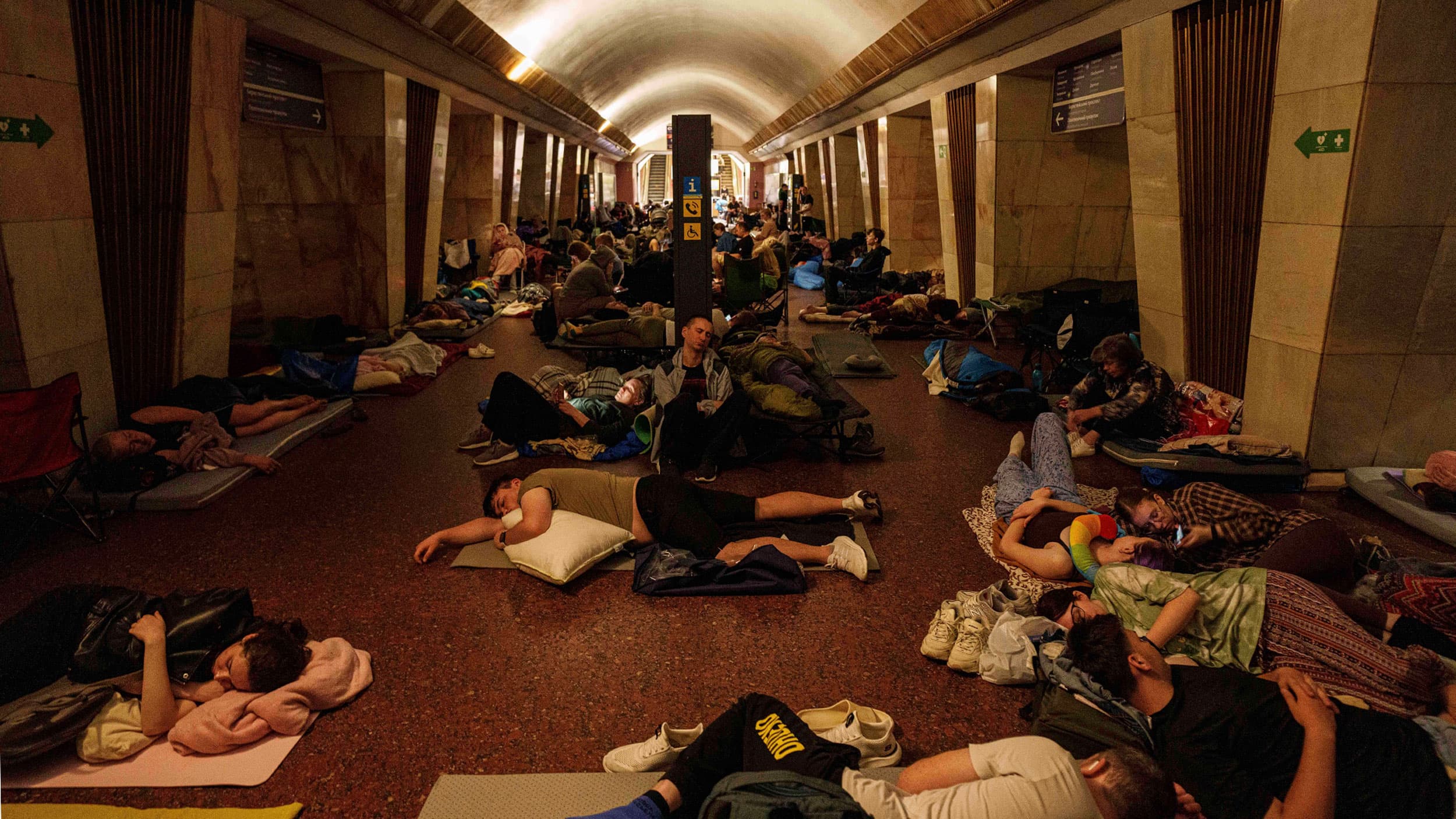
Most wars today happen in urban settings. This impacts the daily lives of civilians, including aspects critical to human well-being, such as sleep. People living through war in Gaza and Ukraine share their experiences with sleeplessness and how they’re trying to cope.
People sleep on the platform of a metro station as they take cover during a Russian attack on Kyiv, Ukraine, July 10, 2025.
Taqwa al-Wawi is a 19-year-old Palestinian poet and writer. She’s been displaced with her family four times since the latest war in Gaza started in 2023.
She says her family is lucky because, when they returned to their home, they found that it was miraculously spared.
In the Gaza Strip, the fighting is constant.
Even at night, when darkness envelops the whole enclave because there is no power, that’s when the struggle begins for Wawi.
“My mind never stops racing, because I worry about my family and everything happening outside.” She said what’s happening outside, with continuous Israeli military strikes, is nothing short of horrific.
Today, most wars happen in urban settings — in places where people live. And it impacts all aspects of daily life, including something that is critical to human well-being: sleep.

The threat of nighttime attacks, displacement and everything else that comes with wars, make it incredibly difficult to get the rest that people in war zones need.
“Every night, I hear drones, helicopters, explosions, constant loud noises,” Wawi said. “And it gives me very strong headaches. Sometimes it feels like my head is going to explode.”
It’s even more challenging because, when she gets headaches, there is no access to painkillers. Israel severely limits the amount of medicine that can enter Gaza.
“I hope that one day, even for just one day, I could sleep peacefully, without fear,” she said.
The constant fear of attacks, the stress of displacement and uncertainty often leave people in war zones lying awake, hyperalert or waking up from nightmares.

But the impact of conflict on sleep goes beyond those living in war zones, including those in diaspora communities.
Zehra Imam, the founder of Illuminated Cities, started speaking with people in the Palestinian territories in 2023, as well as those who had moved away. She found that even people living outside of Gaza had difficulty sleeping at night.
“If you were in the diaspora, it was this guilt about not being in Palestine,” she said. “If you were in the West Bank, then it was guilt about not being in Gaza with your people. If you were in Gaza and you had survived, there was a guilt of survival.”
Imam collected people’s responses and published a few of them on a website called Sleep Testimonies from Palestine. And she said she noticed some patterns emerge, for example, people sleeping in shifts.

“There’s somebody always who’s going to be awake who’s going to be watching in case there’s a drone strike or in case something horrible is happening,” she said.
She found that people also took naps — whenever they could throughout the day. And children slept close to their families as a means of protection.
Imam said the survey ended up becoming an appeal for reaching out to the world.
“You know, we’re always talking about wellness [in the US], and there’s this wellness culture, and sleep is so fundamental, we [even] struggle with it here,” she explained. “So, I was like let’s get down to the basics [to help others relate]. People [there] don’t have this basic right.”

It’s a problem that people living through the war in Ukraine have also been experiencing.
“I feel like we haven’t slept for a year really,” said Maia Mikaluk, who lives in the capital Kyiv.
“Since August last year, we started having nightly attacks,” she said. “Sometimes it’s hundreds, sometimes [even] 700, and we don’t sleep well.”
Mikaluk said she’s been feeling the impact on her body. She feels worn out all the time. And despite exercising and eating well, she said her energy levels are down.
More than 80% of Ukrainians have some sort of sleep problem, according to studies done by Anton Kurapov. He researches the impact of trauma on sleep for the Taras Shevchenko National University of Kyiv.

“They have problems sleeping through the night, they have problems being active the next day after the explosions,” Kurapov said.
Over time, he added, the impact on the body accumulates. “Chronic diseases, they show up more. Or if you’ve [already] had one, it gets worse.”
Kurapov said there are ways to reduce these effects on the body, or at least minimize the symptoms.

“Relaxation exercises, breathing exercises, they help to reduce anxiety a little bit.” He also offered general sleep hygiene tips.
No bright screens at least one hour before sleep. Have some sort of ritual before going to bed, like brushing your teeth or drinking lemon tea. Each situation, of course, is different, and these tips might not work for everyone.
The most effective solution for sleep problems, Kurapov said, is for the war to end — and for healing to begin.