Public radio’s longest-running daily global news program.
©2025 The World from PRX
PRX is a 501(c)(3) organization recognized by the IRS: #263347402.
On Aug. 23, 1973, the legendary salsa label, Fania, gathered together all its stars for a concert to end all concerts — in New York’s Yankee Stadium. Around 45,000 people attended, many of whom were recent immigrants from throughout Latin America. They’d never seen their music represented on such a big stage. Reporter Miguel Santiago Colón brings us the story from New York.
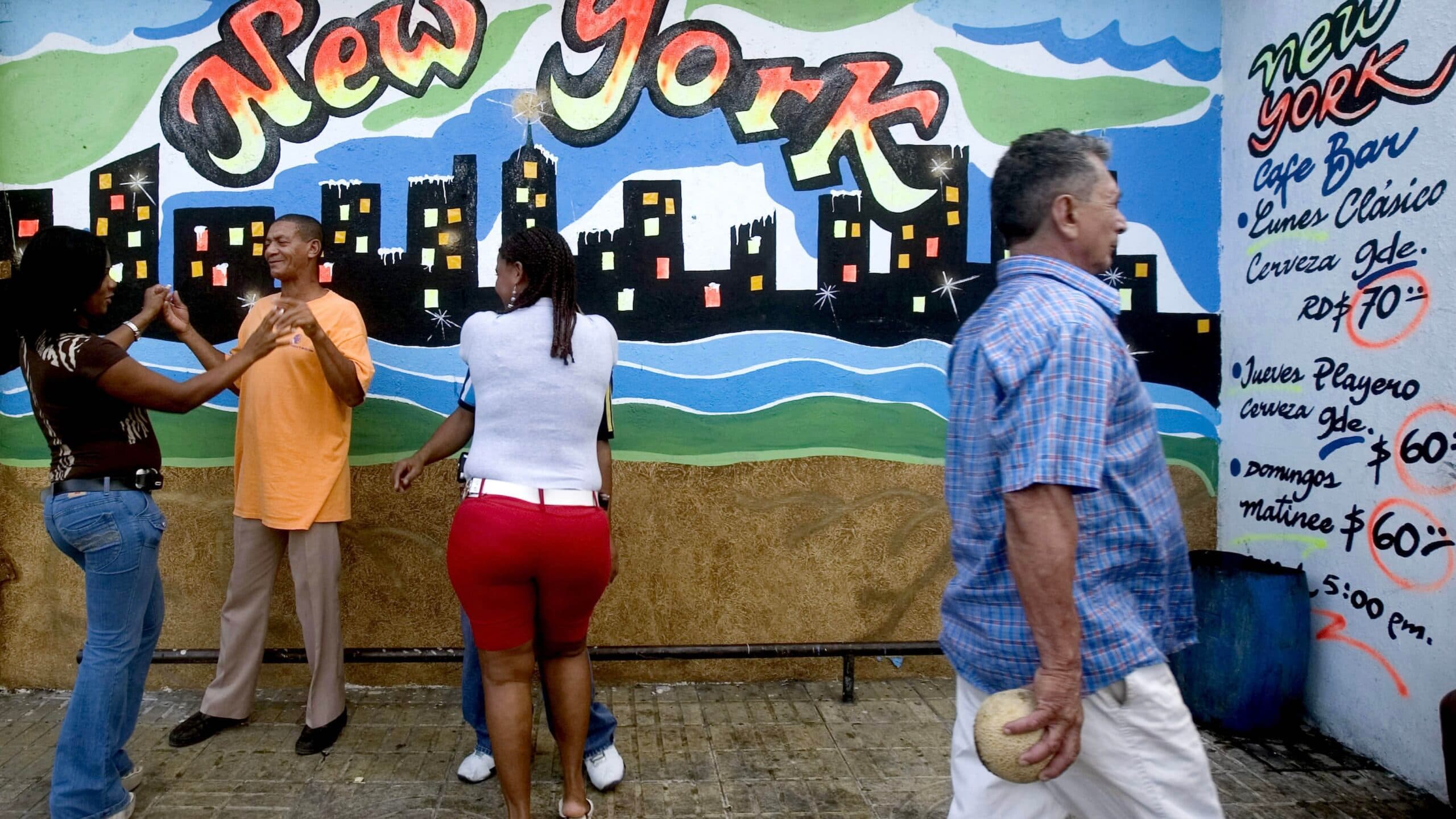
In this AP file photo, people dance at the New York Bar, in Barrio Capotillo in Santo Domingo, Dominican Republic, April 9, 2007. Manhattan-raised Dominican President Leonel Fernandez once pledged to transform his Caribbean country into a “little New York,” an idea that resonated in a struggling nation whose citizens have long fled to Manhattan and the Bronx for a better life.
The night salsa cemented its place in US music history was a night so monumental that the mainstream could no longer ignore it.
Salsa emerged in the late 1960s, just as the boogaloo craze was beginning to fade. The Cuban Revolution had changed the landscape: artists, managers and audiences distanced themselves from anything tied to communism, searching instead for a sound that felt distinctly New York.
Puerto Ricans, Dominicans, Colombians and other immigrants blended the rhythms of their home countries with the fading boogaloo. The music still carried Cuban roots, but with a distinctly New York edge.
“This sound had to feel like it came from New York and not from communist Cuba. That sound was called ‘salsa,’” explained Elmer González, a salsa historian and longtime host on Radio Universidad, Puerto Rico’s public radio.

“Right after that came what I called the ‘art dealers,’ who started thinking of ways to sell music,” González added.
The movement reached its boiling point on August 23, 1973, when the legendary salsa label, Fania Records, assembled its full roster of artists, the Fania All-Stars, for a concert at Yankee Stadium. It was one of the first, if not the very first, Latin music events held at a venue of that scale.
For decades, musicians have hailed that night as a turning point. But one voice often overlooked is that of the audience itself.
Ray Collazo was 20 years old at the time, a local DJ from Philadelphia who boarded a bus to New York for the concert. He described the show as the “Woodstock of Salsa” and, not for nothing, the best night of his life. He recalled that the crowd was so massive and so excited that they flooded the field, forcing the musicians to stop before the show even ended.
“Nothing can compare to that,” he remembered during an interview with The World.

“Just being in Yankee Stadium, with 45,000 people, every time they yelled ‘Puerto Rico,’ the place was like an earthquake.” Collaza said the only thing he could compare the experience to “would be like the American public going to see the Beatles.”
That night, the Fania All-Stars realized salsa’s true power: It wasn’t just Latin music anymore, it was global.