PRX is a 501(c)(3) organization recognized by the IRS: #263347402.
‘It wasn’t designed to work’: A firsthand account of aid distribution in Gaza
The World’s Host Marco Werman discusses the controversies at aid distribution sites in Gaza with Retired Lt. Col. Anthony Aguilar. He served in the US Army for 25 years, and worked for a GHF subcontractor this spring, and says violence at food distribution sites is part of a deeper problem.
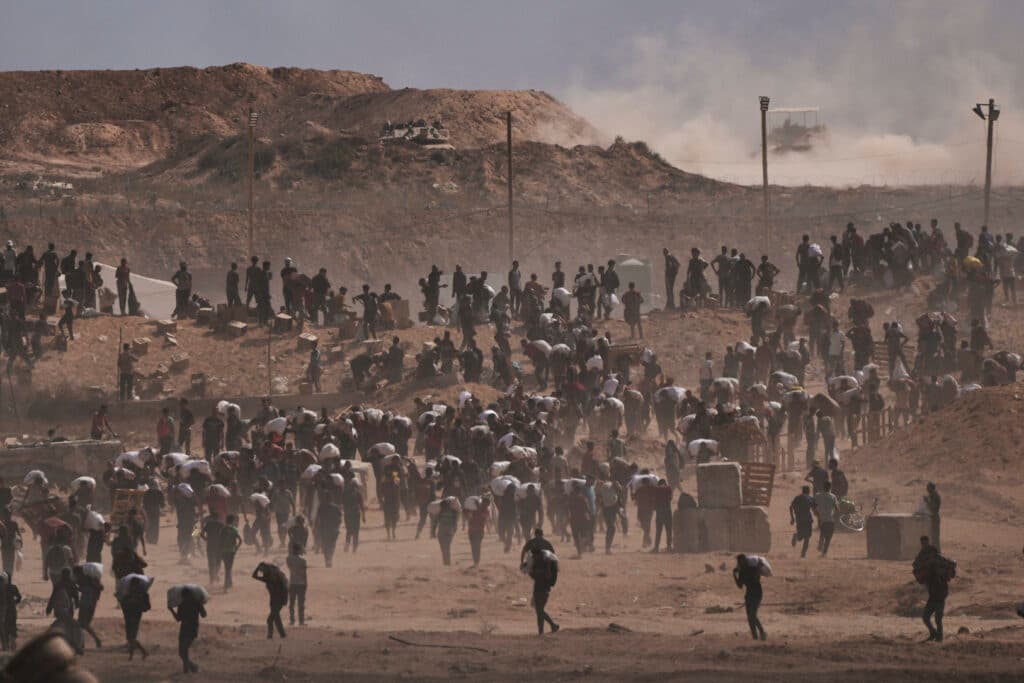
Palestinians carry humanitarian aid packages near a Gaza Humanitarian Foundation distribution center operated by the joint US-Israeli organization, in Netzarim, central Gaza Strip, Aug. 4, 2025.
Abdel Kareem Hana/AP
Prime Minister Benjamin Netanyahu has said that Israel wants to take full military control of the already devastated Gaza Strip. This comes as tens of thousands of Israelis, along with many former Israeli military and intelligence officials, are calling for an end to the nearly 22-month war. And former Prime Minister Ehud Barak has called the operation a war of deception.
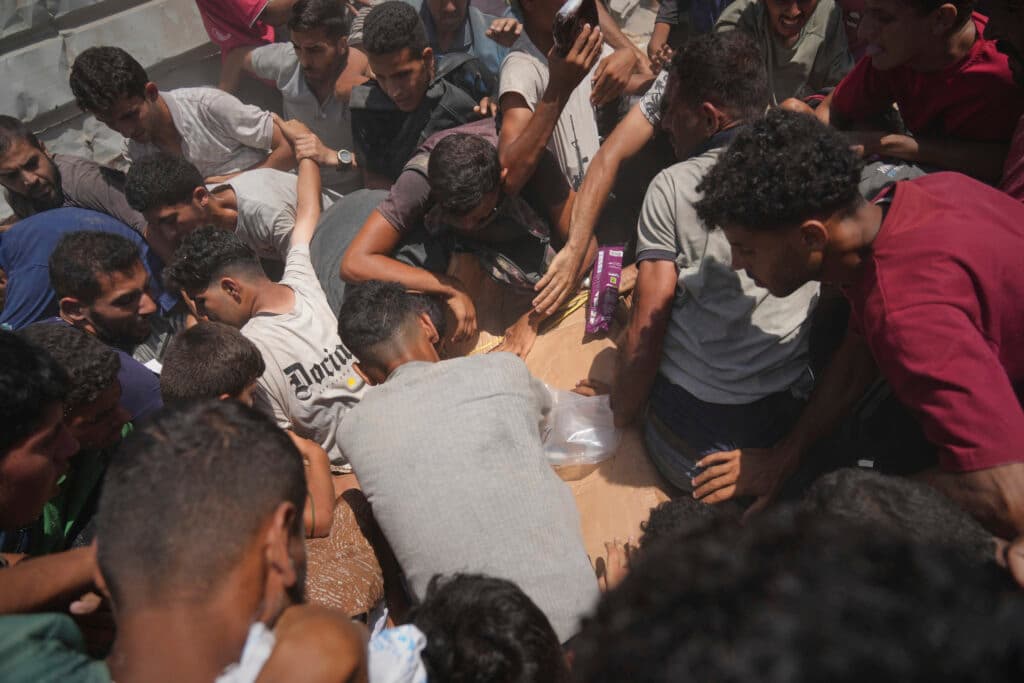
Palestinians struggle to collect humanitarian aid airdropped by parachutes into Gaza City, northern Gaza Strip, Aug. 7, 2025.Jehad Alshrafi/AP
“It has nothing to do with the security interests of Israel,” Barak said in an interview with Sky News. “It has nothing to do with the future of the hostages, probably [even] risking them.”
He said that the war in Gaza is a purely political action intended to keep Netanyahu’s shaky coalition government together — the most right-wing coalition in Israel’s history.
Israeli activists take part in a protest against the war in the Gaza Strip, Israel’s measures regarding food distribution and the forced displacement of Palestinians, in Yad Mordechai, southern Israel, Aug. 6, 2025.Ohad Zwigenberg/AP
Meanwhile, more devastating images have come out of Gaza as aid organizations conduct air drops. The Israeli government’s campaign in Gaza has made it difficult to safely deliver aid on the ground. Images from journalists accompanying a Belgian Air Force flight delivering aid show much of the territory flattened.
Destroyed buildings in the Gaza Strip are seen from a Jordanian Air Force C-130 plane during an airdrop of humanitarian aid for Palestinians, Aug. 7, 2025.Raad Adayleh/AP
Dozens more Palestinians were killed or wounded this week while trying to access food distributed by the Gaza Humanitarian Foundation, or GHF, a group established by the US and Israel. Since May, several hundred Palestinians have been killed according to witnesses. The Israeli military says its forces have only fired warning shots and disputes the death toll.
The World’s Host Marco Werman spoke with Retired Lt. Col. Anthony Aguilar, who served in the US Army for 25 years, including deployments in Afghanistan and Iraq. He worked for a GHF subcontractor this spring, UG Solutions, and said violence at food distribution sites is part of a deeper problem.
He described the scene at these sites in Gaza not just as dysfunctional, but pointed to potential war crimes that he says he witnessed himself.
Marco Werman: Col. Aguilar, explain where military contractors are positioned in Gaza.
Retired Lt. Col. Anthony Aguilar: The Israel Defense Forces (IDF), about a kilometer away from the site, will hold the crowd back until the aid is on the site and the delivery trucks and the delivery personnel are off the site so they’re not in any type of risk or danger. Once that’s complete, the IDF moves out of the way. They usually hold the line, which is a military corridor along the coastal road of the Mediterranean Sea that comes into southern Rafah.
And they usually hold that line with tanks utilizing small arms fire, machine gun fire, fired at the crowds, feet of the crowd to keep them back. And once they release that line, the entire crowd — any given time, sometimes 6,000, sometimes up to 9,000 or more — in one mass rush come towards the site. If you can envision in your head, like the start of the Boston Marathon or the start to the New York City Marathon, just this massive rush where the fastest, the strongest get to the front first, they get there first.
Having been on the other end of it on site, pre-opening and during opening, you can hear the growing crowd begging to be let go for food. The growing of the crowd in the distance, it’s kind of unnerving, because you know that you’re there on this site and there’s only 22 to 24 people there securing a site and you have potentially thousands of people coming to your location.
Palestinians carry humanitarian aid packages near a Gaza Humanitarian Foundation distribution center operated by the US-backed organization, in Netzarim, central Gaza Strip, Aug. 4, 2025.Abdel Kareem Hana/AP
So, let me just ask you something, because you said security fires at the crowd, almost as if that was anticipated, almost part of the job. But that can’t possibly be part of the real protocol, is it?
From the IDF perspective, I don’t know what their written protocols or what their written operating procedures are. But I do know that, in practice — the shooting at civilians, shooting at their feet, shooting over their head, sometimes just based on the nature of terrain and the crowd, the bullets go into the crowd — that is a standard practice. That happens almost as if it was a rule to which it is supposed to happen.
UG Solutions was the subcontractor for GHF that you were part of, correct?
Correct, sir. UG Solutions is the subcontractor for Safe Reach Solutions, which is the subcontract to the GHF. So, it’s kind of like this nesting doll of contracts. The inner doll of that, so to speak, is the UG solutions security component, specifically subcontacted for armed security for protection of the aid on sites and to the sites.
We, as UG Solutions contractors, were given no rules of engagement, we’re provided without any clear standard operating procedures, we weren’t trained on any non-lethal munitions, stun grenades, tear gas. We weren’t provided any escalation of force measures nor did we do rehearsals or go through with the leadership, you know, on how that would look like in terms of engaging with a crowd of that size.
So, what UG solutions personnel did is pretty much just adopt the ways of the IDF, which was shooting at their feet, shooting over their head. And what’s been said in numerous occasions by not only the attorneys for the GHF, but also by the official spokesperson of the GHF, that the contractors shoot at their feet, over their heads, and sometimes out towards the sea. If you’re a UG contractor and you’re shooting out “towards the sea” the entire coast of Gaza, from the north to the south, the entire coastal road, is just inundated with hundreds and thousands of people who are queuing from the north to wait for the opportunity to go to these different sites.
So, if you’re a UG Solutions contractor shooting live ammunition as a means of warning or communication, you are putting civilians in danger. You’re shooting into a crowd of people. So, those practices that were adopted were just very uninformed, very, very negligent, high risk. And to be quite frank, they are violations of the protocols of the Geneva Conventions. Firing at unarmed civilians using live ammunition to fire at them for the purpose of controlling or moving them is verbatim a violation of Geneva Convention.
War crimes. Is that what you’re saying?
Yes, they are war crimes.
Mourners carry the body of a Palestinian man who was killed while trying to reach aid trucks entering northern Gaza through the Zikim crossing with Israel, July 31, 2025.Jehad Alshrafi/AP
On paper, what was your job?
So, when UG Solutions first hired me, I was hired as an independent security contractor. After the second day in Israel, I stepped up, so to speak, to take on a planning role because they didn’t have anybody in that role, which was shocking to me that they didn’t hire anybody into this critical planning role. By the May 21, I was promoted to the Joint Tactical Operations Center team leader. Five days after that, the second in charge of the entire contract in country from UG Solutions resigned in protest over his concerns with the performance. So, I was offered that job and put in that job. So I promoted twice, two pay raises within a nine day period.
In other conflict zones or situations where you’ve done similar work, how did the training and preparation compare with what you were doing in Gaza?
No rehearsals of the actual process of distribution. We didn’t do any collective planning by bringing all of the contractors together to inform them like “this is how this is going to work.”
Nothing at all? They didn’t like give you a YouTube video at least?
Nothing. We didn’t get a YouTube Video. We didn’t get a briefing. We got no training on crowd control or riot control procedures. We were given an arsenal of non-lethal munitions — stun grenades, tear gas, pepper spray, rubber bullets, batons — and never given any training whatsoever on how to employ or use any of those things, nor were we given any training or briefing on the escalation of force or what our legal authorities were. And remember, we were all there on a tourist visa.
Palestinians carry humanitarian aid packages near a Gaza Humanitarian Foundation distribution center operated by the US-backed organization, in Netzarim, central Gaza Strip, Aug. 4, 2025.Abdel Kareem Hana/AP
I understand you saw some disturbing stuff in Gaza and you filmed video of at least one troubling incident. Some screaming at the end, “I think you hit one,” and then somebody else screamed. Tell us what was happening there.
So, that was on May 29, and that was at secure distribution site number four. Distribution had ended for the day. All of the civilians were off of the site. Gates were closed, security had pushed to the perimeter, there was no one onsite. One of the additional jobs I was given was to film and take pictures of everything. So, as I’m walking through and I’m filming the berms and you hear the first guy yell, “That’s the only way to keep them back.” None of the voices in the video are mine, it’s other contractors. And then the shooting starts and it kind of startled me because I didn’t know what we were shooting at because we aren’t authorized to use lethal force, i.e. pulling the trigger of your rifle, warning shots or not, we aren’t allowed or authorized to use any type of shooting or munitions against its civilian population just to control them or scare them.
The gunfire in the video was live fire?
That gunfire that you hear is live ammunition, lethal ammunition being fired from an assault rifle of a UG Solutions contractor who’s standing on the berm in front of me. In the beginning of the video, as I’m first turning, you see the contractor that’s running in front me right before the other guy says, “I think that’s the only way to hold him back.” That guy runs up onto the berm and he’s shooting from the berm towards the exit lane of the site. That shooting that you here is not an accidental shot or just a warning shot. He shoots quite repetitively.
Let me ask you a few questions here. So, first of all, these, you’re certain, were not IDF personnel?
These were absolutely without question not IDF. The IDF aren’t physically located on the site or with us at the site. And I’m on the site. I’m inside of the site and the audio itself has been validated by other media outlets to show that that’s not from a distance. That’s not an Israeli weapons system firing. That is the type of weapon that we were issued, which is the IWI assault rifle.
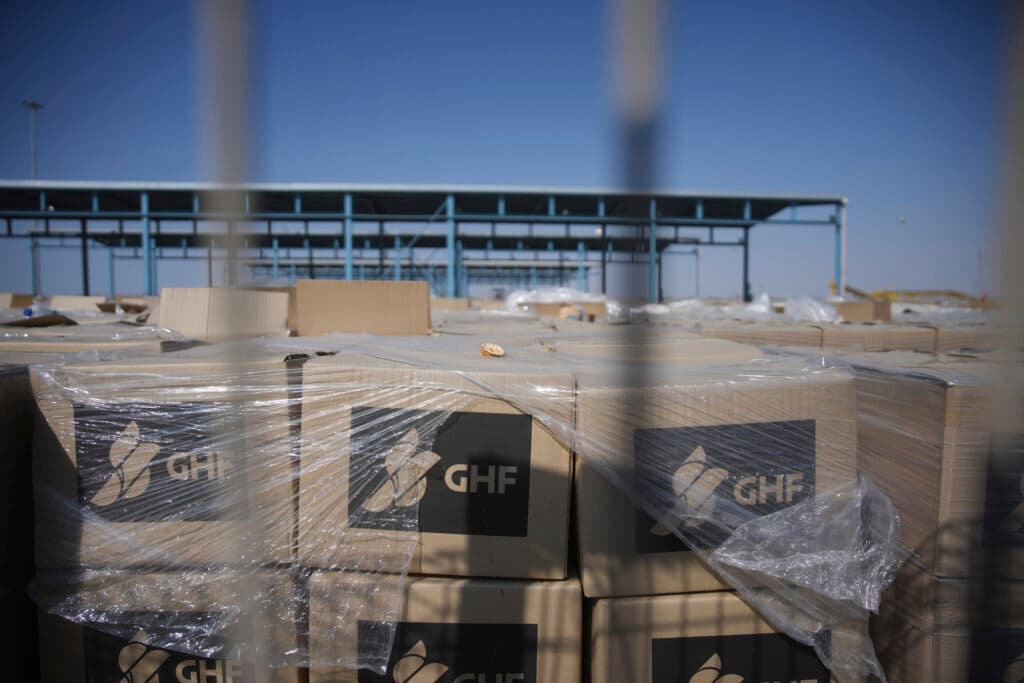
Piles of humanitarian aid packages from GHF , Gaza Humanitarian Foundation, wait to be picked up on the Palestinian side of the Kerem Shalom crossing in the Gaza Strip, July 24, 2025, during a media tour organized by the Israeli army.Ohad Zwigenberg/AP
How did you know for sure that this was indeed what was going on, targeting or potshots taken on Palestinian civilians?
Myself and another gentleman are standing about two feet from each other. My rifle was in my right hand and I’m pulling security and I was just kind of panning with my left when that happened. You hear the guy next to me, he says something like, I think there’s an expletive, and “that’s the only way to hold him back.” What he’s talking about is pushing the civilians back over the bridge. There’s a bridge that comes over from the town into our area. But pushing civilians back over the bridge or security outside the site is not our responsibility, nor our authority, at all.
So, when the guy on the berm who you can’t see in the cut of the video, but he’s standing on the berm and he starts shooting and you hear it. And then you hear the insightful calling of the “woo-hoo.” And then the other guy on the ground says, “I think you got one.” The guy that says, “I think you got one” is in front of me in the video wearing a hat walking around. But that guy and I, we saw the same thing. What happened as this guy’s shooting, at the very end of that exit, it opens up and that’s where the Palestinians were. Some of them were dragging their bags because they were heavy. Some had stopped to sit because it was very exhaustive and they’re not wearing shoes and they are starving. They walk slowly, they stop to sit. They stop to get their stuff organized before they continue on their 8 to 10 kilometer journey.
And this guy starts taking warning shots at them to get them to continue to move. And bullets are flickering all around the feet, into the berm, over their heads. And then this guy that’s there just drops to the ground, and he’s not moving. And he didn’t move. And then you hear that gentleman say, “Oh, I think you got one.” What he’s referring to is that that “got one” is a Palestinian unarmed civilian who dropped to the floor. Then the other guy, you hear him respond with that, “Hell, yeah boy.” They were celebrating it. That was not the IDF shooting. That wasn’t the IDF in the area. The IDF weren’t even on the southern part of the berm.
We should add here that your former employer at the Gazan Humanitarian Foundation says, “No Gazan civilians have been shot by UG Solutions personnel,” period. Your reply to that?
That is an ignorant and negligent falsehood. There’s video proof of it.
I mean, the fact is the violence at these sites has been happening just about daily and has killed many hundreds of people. At its root, Colonel, why do you think this is happening?
The sites themselves were built deliberately with intention in active combat zones, so, where war fighting is going on.
I mean, isn’t all of Gaza a combat zone? So, like, what is the option?
No, because within Gaza, you have areas that are being contained and secured, but there’s not active fighting. These sites were put into locations where there was active, offensive combat operations.
An Israeli soldier stands beside humanitarian aid packages awaiting pickup on the Palestinian side of the Kerem Shalom crossing in the Gaza Strip, July 24, 2025, during a media tour organized by the Israeli army.Ohad Zwigenberg/AP
So, Israeli officials say the crowds are infiltrated with Hamas fighters and that Hamas instigates this violence. Did you see evidence of that?
No. So, again, I have asked the question before, “What is Hamas?” Do they walk out and wear a Hamas T-shirt? Do they have a name tag? Never in the entire time that I was there and worked at all four of the sites did I ever encounter or see anyone dressed as Hamas in a Hamas type of uniform, anyone proclaiming to be Hamas. I didn’t see any type of organized resistance, never saw a Palestinian carrying a rifle or a gun, never experienced a threat, never experienced any type of hostile behavior. And I didn’t just work one site. I did all of the sites.
Beyond that, though, is that let’s just say for sake of argument, if a Hamas fighter was in the crowd and they’re wearing a distinctive uniform to say we’re Hamas, well, they’re combatants of the Israeli Defense Force. But in terms of us, our position on the ground, we aren’t combatants. We do not have the authority to kill a quote, unquote “identified enemy.” We are not fighting in the war.
Palestinians carry humanitarian aid packages near a Gaza Humanitarian Foundation distribution center operated by the US-backed organization, in Netzarim, central Gaza Strip, Aug. 4, 2025.Abdel Kareem Hana/AP
So, I did resign on the June 13 and I provided it not only in writing, I provided it over — we were directed and dictated that we would use Signal chat messaging for everything. So, it was provided to the leadership and it was in writing. They say they fired me. I have never received, nor have they ever produced, any documentation to show that. I have all the documentation that counters what they are saying in terms of my performance. They promoted me twice in the time that I was there.
You must know that the Gaza Humanitarian Foundation was controversial from the very start. What were your expectations when you took this job?
I took this contract and went on this job because I really felt that, based on how it was explained to us, that we were going to make a difference — to feed people and to provide food to a starving population. I felt that that was a noble cause that I wanted to be a part of. Upon getting there, I soon learned that it was anything but that. On the May 26, the day we started distribution, the start of the project, cutting the ribbon, so to speak, the executive director of the Gaza Humanitarian Foundation stepped down, Jake Wood. The day we began the operation, the guy in charge of the entire thing stepped down in protest to how the thing was being executed.
There was a recent investigation by the Israeli newspaper Haaretz. You’re probably aware of it. It cited unnamed IDF soldiers and officers alleging that commanders have issued orders to shoot at unarmed Palestinians waiting for aid even when they pose no apparent threat. Did you see any evidence of that?
Well, I saw them doing the shooting. Did I personally hear or was I present for that order being given from IDF officers to IDF soldiers? No. But based on the actions of the IDF shoulders, shooting into the crowd, shooting at the crowd shooting at this civilian population, it would indicate to me that yes, that wasn’t just one or two people doing it. That was some kind of collective guidance.
And you were certain that those soldiers were in IDF uniforms?
Yeah, they were shooting from IDF tanks, from IDP positions, IDF uniforms, IDP vehicles. Yeah, absolutely, without a doubt.
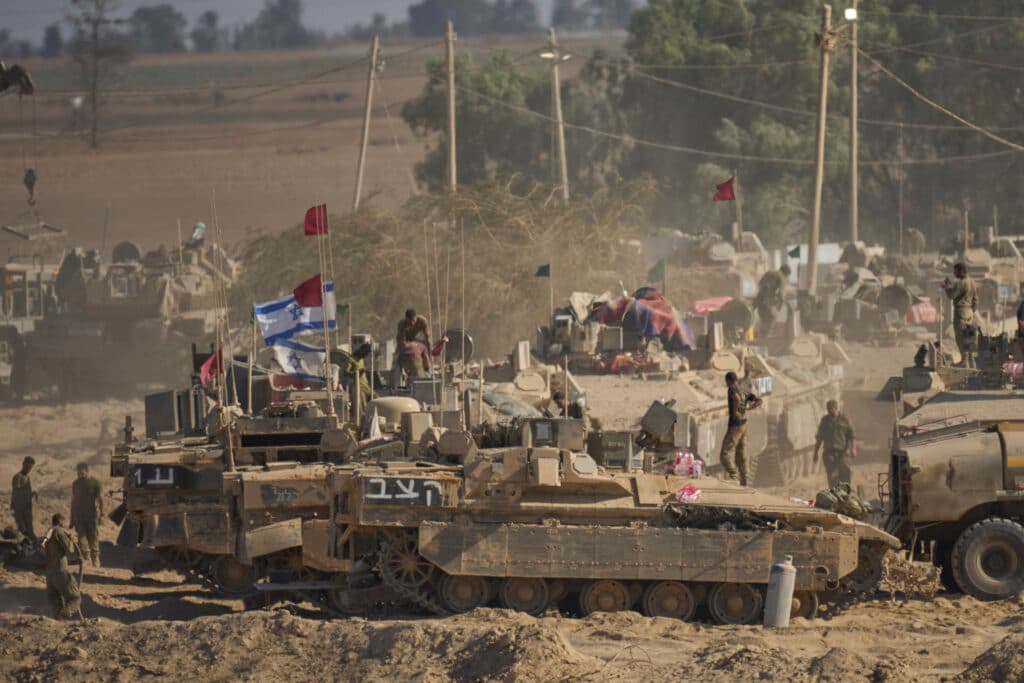
Israeli soldiers are seen near the Gaza Strip border in southern Israel, Aug. 6, 2025.Ohad Zwigenberg/AP
So, you said in the press that you joined this operation because you believe there’s crucial work, life and death work, to be done to prevent starvation in Gaza. You are a security expert, but I wonder since you’ve been on the ground and seen that it doesn’t work, whether you have any thoughts about how to actually get these people fed.
The process doesn’t work because it wasn’t designed to work. What needs to happen if we’re truly serious about feeding the population and safeguarding the civilian population, the UN process needs to be re-energized with the funding, with humanitarian assistance corridors, not militarized corridors, and not humanitarian assistance displacement villages or camps. Humanitarian assistance corridors that are secured, where the trucks can move into a site without being worried about being ransacked to a point where they can then deliver in scale. If there’s only one point delivering, of course, hundreds of thousands of people are going to go to that one point. So, the process that can work, we already have the mechanism, we have the elements in place. And plus, with the United Nations, you get people that are experts in humanitarian assistance, doctors, veterinarians, nurses, teachers, nutritionists, because humanitarian assistance isn’t about “here’s some food.” It’s also about sewage surveys or “this pump’s broken, we need to fix that.” So yeah, the UN mechanism needs to be reinstated, supported and actively supported by the international community.
This interview has been lightly edited and condensed for clarity. Click on the blue player above to hear the entire discussion.