PRX is a 501(c)(3) organization recognized by the IRS: #263347402.
Ukrainians protest new law weakening anti-graft agencies in the country
Protesters took to the streets of the Ukrainian capital Kyiv in the first anti-government protests since the start of Russia’s full-scale invasion of the country. Ukraine has long struggled with corruption, and it’s been a significant barrier to joining the EU. The World’s Host Carolyn Beeler spoke to Andrii Borovyk, head of the corruption watchdog Transparency International Ukraine, who joined from Kyiv.
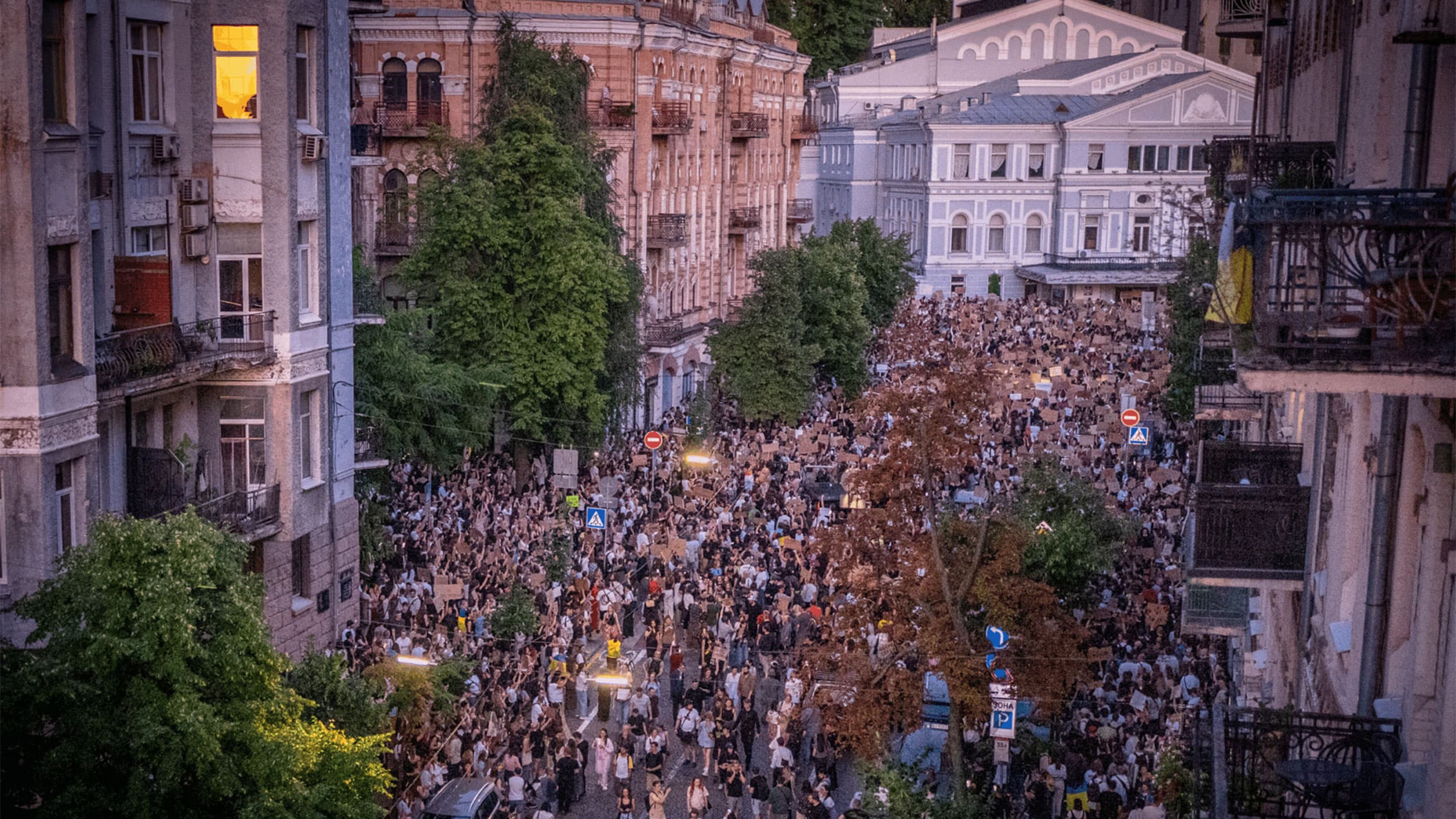
Thousands of people protest against a law targeting anti-corruption institutions near the President’s Office in Kyiv, Ukraine, July 23, 2025.
Dan Bashakov/AP
Hundreds of protesters took to the streets of Ukraine’s capital, Kyiv, this week to protest a move by President Volodymyr Zelenskyy to assert more control over the agencies that investigate corruption in the government.
The demonstrators shouted, “The people are the power.”
Corruption has been a major issue in Ukraine for a long time, and these protests are the first against the Zelenskyy government since Russia’s full-scale invasion three years ago.
Later, in a video message on Telegram, the president did say he was listening to protesters and would propose a draft law to give back more independence to the anti-corruption agencies.
The World’s Host Carolyn Beeler spoke with Andrii Borovyk, the head of the corruption watchdog Transparency International Ukraine about the latest.
Carolyn Beeler: What did the president do to cause this backlash from citizens?
Andrii Borovyk: This new law gives the prosecutor general of the country more control over the two institutions established over the last 10 years with the support of our Western partners: the Anti-Corruption Bureau of Ukraine, which conducts investigations, and the Special Anti-Corruption Prosecutor’s Office.
Additionally, this law also limited their independence, meaning that the general prosecutor can now see which cases they are investigating and decide whether to investigate them or refer them to another law enforcement agency.
Additionally, top-level state officials can now only receive suspicions that it’s part of the criminal process from the general prosecutor, which means that the autonomy of these two institutions is now quite limited. And this autonomy is significant because only in this way can these two institutions effectively combat top-level corruption and avoid concerns about any kind of leakage or political influence.
So, the prosecutor general, who will now head up these two anti-corruption bodies, answers to the president?
Not exactly. The prosecutor general is nominated by the president and appointed by the parliament. So it’s, let’s say, both.
You can see why there might be a perceived conflict of interest. And this has upset Ukrainians. As I said, they’ve taken to the streets. Explain why this is seen as such a big deal there.
People are mad because of the way it was done, the speed at which it was done and the fact that the second part occurred after the Revolution of Dignity.
The Maidan Revolution?
Yes, back in 2014, when it was completed, we were building these institutions, along with numerous other reforms we implemented. But these two are dealing with cases where corruption has already occurred and investigating some of the highest-profile cases. And people just remember what it was like during the [Viktor] Yanukovych times.
That is the Russia-aligned predecessor of Zelenskyy?
Yes, right. They don’t want to see that level of influence. They see the results of these two institutions, probably, because they’re investigating members of parliament, as well as ministers, deputy ministers and judges. So, they have already proven that for them, the rule of law is not just two random words. And they see that everybody should be accountable.
Demonstrators hold sign during a protest against a law that targets anti-corruption institutions in Lviv, Ukraine, July 23, 2025.Mykola Tys/AP
President Zelenskyy justified the changes by saying he was trying to root out “Russian influence” in these agencies. Is there proof of Russian influence there?
On Monday, this week, a couple of suspicions were issued to detectives of the Anti-Corruption Bureau of Ukraine. So, this happened. However, I believe that some individuals in the political elite decided to use this as an excuse to do what they did. But the situation is developing now, even at this moment, over the last hour. And I think it would be interesting to know that President Zelenskyy just made a statement less than an hour ago, stating that they are preparing a new bill to bring back a decent level of independence to these two anti-corruption bodies.
Is that being seen as him walking back this change, with the prosecutor being put in charge of these two anti-corruption agencies in response to protests?
For me, it means that we are still a democracy because you see people on the street, and that maybe the president — I’m saying maybe, because we haven’t seen the draft bill submitted yet — can hear the citizens.
We’ve mentioned that corruption has long been a problem in Ukraine. There have been many efforts, as you said, since the end of the revolution in 2014 to eradicate it. How successful have those efforts been?
I must say that if we look back further in time, to the last 11 years, Ukraine today and Ukraine in 2013, the last year of the pro-Russian Yanukovych presidency are just two different countries in terms of corruption. We have made significant progress in the Corruption Perception Index, an index developed by our organization based on our methodology, not personally by us. And we earned more than 10 points over this period. And if we compare it to other 170 countries, we will be in the top 15 [of countries that are] progressing the most.
A man waves a flag during a protest against a law targeting anti-corruption institutions in central Kyiv, Ukraine, July 22, 2025.Alex Babenko/ AP
You mentioned that President Zelenskyy has announced steps to ensure proper oversight and independence for these two anti-corruption agencies. We will learn more about what those changes are in the coming days, I am sure. But what do you think they would need to be for protesters to once again have faith in the government and the president?
Stop doing such things as they did on Tuesday. If they would take at least some pause to reconsider such ridiculous steps and think twice, maybe study public opinion more thoroughly and not rush to make amendments in such speedy procedures, but instead holding more consultations and discussions before making a final decision, there will be more trust. So, just talking to their people is all that’s needed.
This interview has been lightly edited and condensed for clarity.