Public radio’s longest-running daily global news program.
©2025 The World from PRX
PRX is a 501(c)(3) organization recognized by the IRS: #263347402.
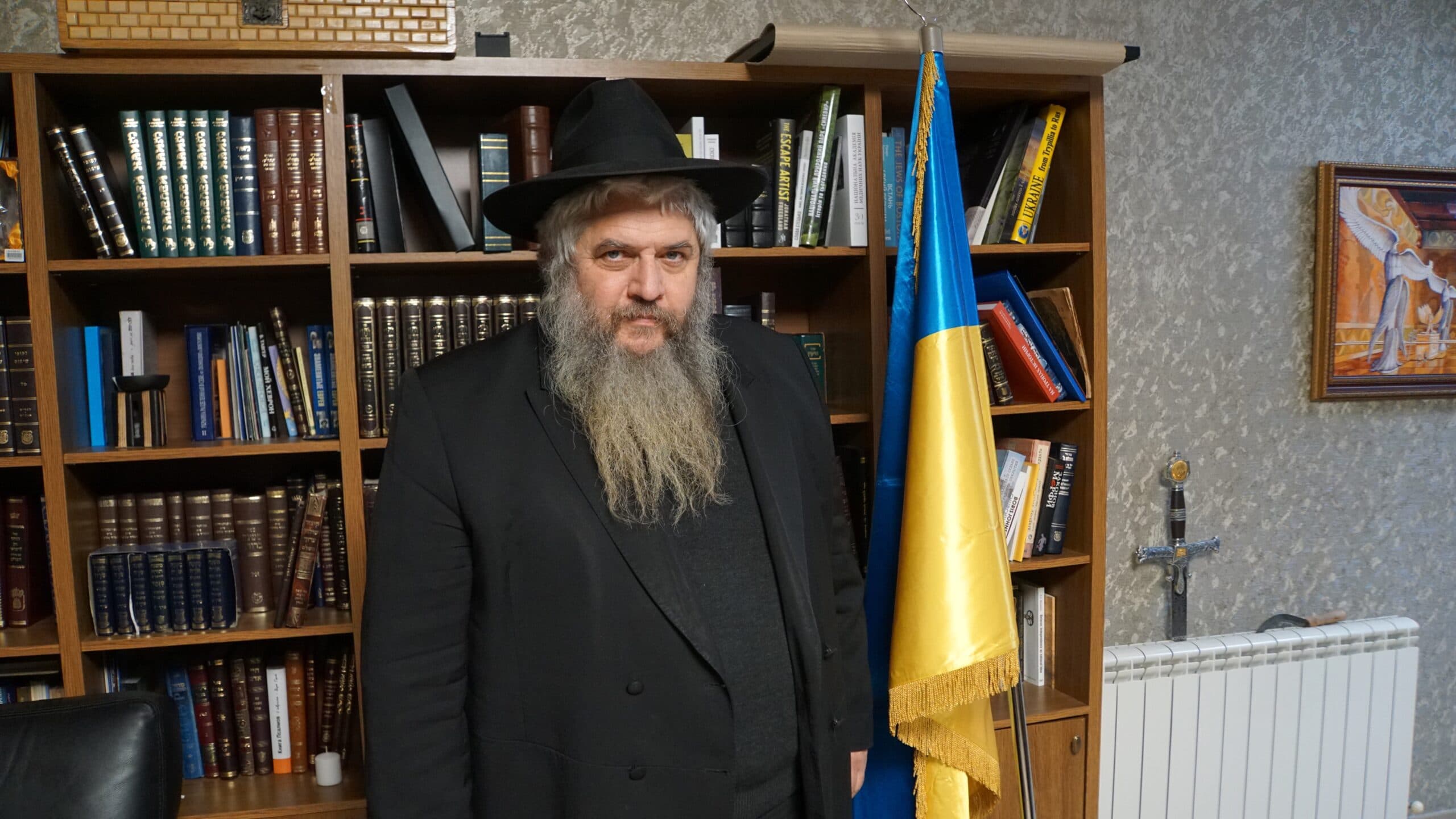
Ukrainian President Volodymyr Zelenskyy wasn’t the only leader who decided to stay in Ukraine after Russia’s full-scale invasion. Other politicians, athletes, cultural figures and religious leaders also remained — including one of Ukraine’s chief rabbis, Moshe Azman, who stayed in Kyiv and continues to lead his congregation.
Rabbi Moshe Azman, one of the chief rabbis of Ukraine and rabbi of the Brodsky Synagogue in Kyiv, Ukraine.
In the early days following Russia’s full-scale invasion of Ukraine in 2022, Ukrainian President Volodymyr Zelenskyy decided to stay put in Kyiv, despite all the risks.
His decision not to flee remains a strong symbol of Ukrainian resistance. For many civilians, this was a sign of confidence that Kyiv would stay under Ukrainian control and would not fall to the Russian military.
Zelenskyy wasn’t the only leader who chose to stay in Ukraine. Other politicians, athletes, cultural figures and religious leaders also remained — including one of Ukraine’s chief rabbis, Moshe Azman, who stayed in Kyiv and continues to lead his congregation.
“I understood that it is a real time that I can do what I can to save people, to help people,” Rabbi Azman said. “Now, I can say that I thank God that he gave me the opportunity to be in the right place at the right time.”
Azman said that in those early days of war, he was working nonstop. His priority was to help evacuate people who wanted to flee the country.
Soon, Azman’s synagogue, the Brodsky Shul in the center of Kyiv, became a hub for humanitarian assistance and a meeting point for those looking to leave the country. Around that time, Azman became much more of a public figure in Ukraine.

“Before the war, I didn’t like to be famous — to be in the video, in the social media, in the television. I was a quiet man.”
Azman said that the war changed his public image. One event, in particular, drove him to speak out more and post videos on social media.
On March 1, 2022, Russian missiles hit the main television and radio tower in Kyiv, and also the nearby Babyn Yar Holocaust memorial site.
“They attacked Babi Yar, and it was the last [straw]. And I took the scroll of Torah from the arch and called to Russians, because I was born in Russia, it was the Soviet Union, in Leningrad, and my Russian is my native language. I called on Russians to stop the war, it was the voice of my heart.”
In the video,Azman said, “Even in my nightmares, I never thought that I would have to die from Russian shelling.”
“The place where I was born, where I went to school, and where I have many friends — who are now silent.”
Azman implored people in Russia, not to believe what they’re being told on TV — “They’re lying to you,” he said.
Since then, Azman said that he’s felt less inclined to address Russians.
“Because there are so many tears that Russia has brought to Ukraine. I by myself, a Russian speaker, have tried to speak Ukrainian. It’s one of my ways of supporting Ukrainian people, spiritual support.”
The war has also brought pain and hardship to his immediate family.
In July of last year, Azman’s son, Anton “Matityahu” Samborskyi died while serving in Ukraine’s armed forces.
When the war started, Samborskyi didn’t immediately join the military — family life was his top priority. But Samborskyi was drafted in May of last year, less than two weeks after the birth of his daughter.
Samborskyi was sent to the front lines in eastern Ukraine after just a few months of training.
“One day, he disconnected, and after this, his wife received a letter from the army, that he [was lost in action],” he said. “He was killed in a battle.”
The army couldn’t get to him right away because it was a battle zone, but later, the family was able to find him and bury him.
They held a funeral in September — about two months after Samborskyi was killed in action. At the funeral, Azman read from the book of psalms and prayed for Ukraine’s victory.
Last week, Samborskyi was posthumously awarded an “Order for Courage” medal for his service.
At the award ceremony, a soldier who served with him said that on multiple occasions, Samborskyi provided first aid to injured soldiers while being under mortar fire.
He also helped repel a Russian attack on their position. The soldier said that Samborskyi stood for “bravery, courage, and heroism.”
Azman said that he will continue trying to do good deeds in his son’s honor — for his memory to be a blessing for others.