Public radio’s longest-running daily global news program.
©2025 The World from PRX
PRX is a 501(c)(3) organization recognized by the IRS: #263347402.
Amid a public health emergency, there is usually a great deal of interest in prevention and preparedness, but over the years, these waves of interest in public health wane. Dr. Howard Koh of Harvard’s Harvard T.H. Chan School of Public Health and the Harvard Kennedy School urges continued investment in public health care systems at every level, from local to federal.
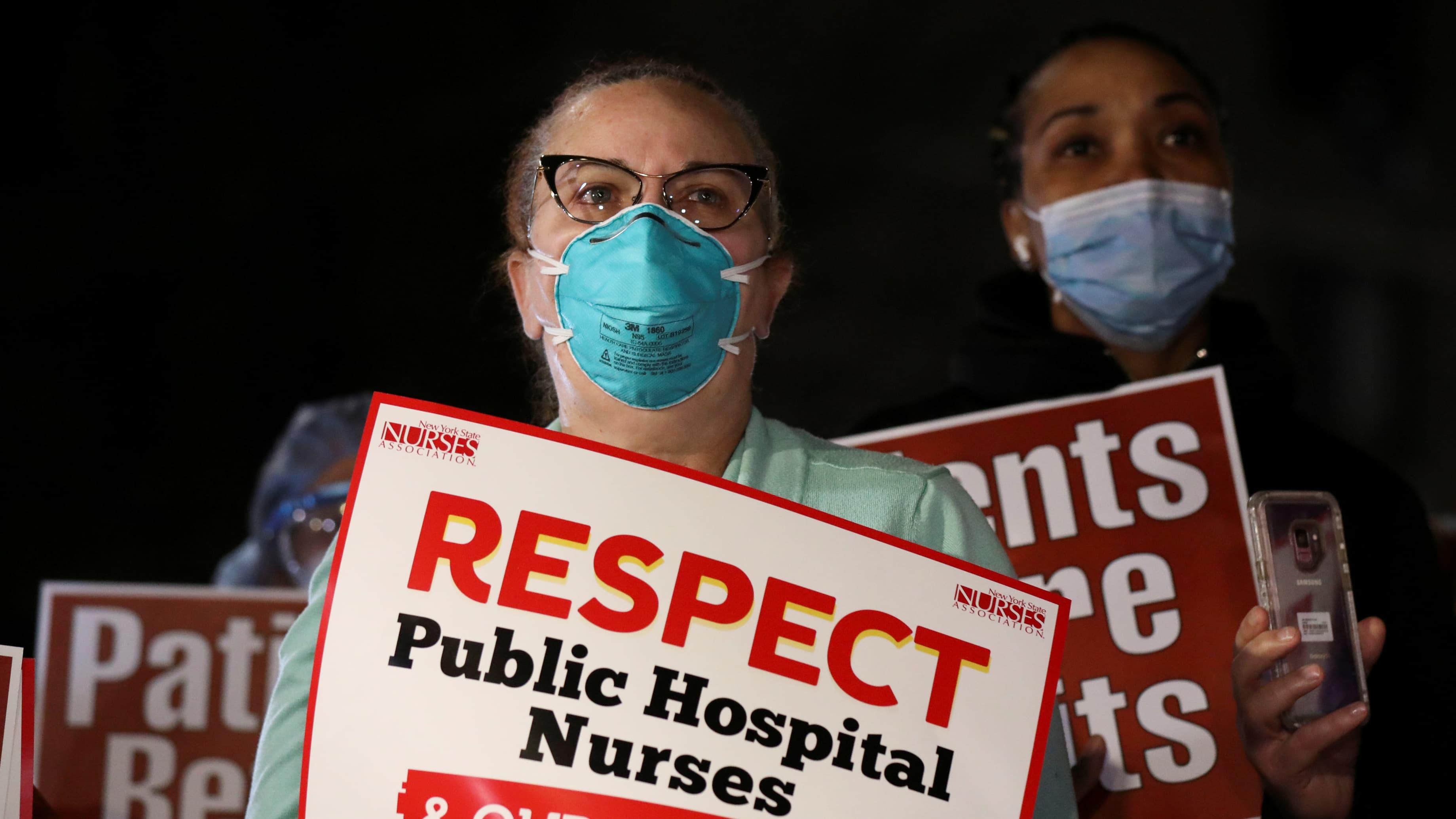
Nurses at Montefiore Medical Center Moses Division hospital hold a protest demanding N95 masks and other critical personal protective equipment (PPE) to handle patients during the outbreak coronavirus disease (COVID-19) in the Bronx borough of New York City, New York, April 2, 2020.
The coronavirus pandemic has underscored the critical role of public health in protecting people around the world. But the crisis has also exposed the need for more investment to help prevent a pandemic of this magnitude from happening again.
As part of our weekly series taking your questions to the experts, The World’s Elana Gordon moderated a discussion with Dr. Howard Koh, Harvey V. Fineberg professor of the practice of public health leadership at the Harvard T.H. Chan School of Public Health and the Harvard Kennedy School, as well as the 14th assistant secretary for health for the US Department of Health and Human Services.
Koh addressed the response to the current pandemic and how it intricately ties to strengthening and building a better public health system that builds on hard-won lessons.
As countries begin to emerge from lockdowns, shutdowns, and stay-at-home orders, many scientists, researchers and public leaders are fearful of a second wave of the coronavirus in the fall. The pandemic has made the value of public health more visible than ever before. This is the time to build global health initiatives and send a message of a unified response.
“We have not had the national coordination that we need when a national emergency is declared. That means the federal government should be in the lead. And if we had more explicit federal coordination on guidance standards, testing, contact tracing, coordination of PPE [personal protective equipment] and so many other dimensions, we could have a much more unified response going forward.”
US President Donald Trump’s recent threat to defund the World Health Organization is “absolutely the wrong message,” according to Dr. Koh. “We need to leading global health efforts, not undermining them,” he said.
Amid a public health emergency, there is usually a great deal of interest in prevention and preparedness, but over the years, these waves of interest in public health wane. As Congress convenes to discuss stimulus bills and support for public health workers, Dr. Koh advocates for a unified system in terms of standards, guidance, consistent health messaging, and state-level coordination.
“Everybody is committed to better preparedness and response. But what I fear is that over time, that funding will go down yet again. We just can’t let that happen. So, as Congress is putting forward funds and stimulus packages, we need funding for hospitals, for community health, for contact tracers, for health workers, for prevention, for public health. And we’re going to have to make that system so much stronger going forward.”
Testing and contact tracing at the local level are key principles in public health and those engaged in contact tracing at the local level should not just go away after six months. Instead, they can be shifted into public health workers who monitor public health in a broader way as part of community-based prevention strategies.
As America grows more and more diverse, public health must address disparities among vulnerable groups. The coronavirus pandemic has revealed how communities of color continue to experience gross inequity when it comes to health care.
The US currently administers about 350,000 tests per day, according to Dr. Koh, and that number “has to go up in orders of magnitude. Testing is critical particularly in high-risk places such as nursing homes, prisons and communities of color.
“Our country is getting more diverse by the day. That’s what makes America strong. … And we have, by the way, a more diverse society going to many other dimensions in addition to race and ethnicity … [such as] sexual orientation, level of disability, or rural versus urban. So, as we move forward, the tensions of high-risk populations that are really taking a lot of the burden here are going to be even more important than ever before.”
In a world with 8 billion people, the pandemic trend will continue. The world is growing smaller every day and increased contact between humans and animals also heightens the likelihood of future pandemics.
The Centers for Disease Control has been effectively sidelined as global leaders during this pandemic. Dr. Koh urges policymakers to follow the science to inform policies and guidelines moving forward.
States have the power to recommend and enforce quarantines and other measures to mitigate the spread of contagious viruses using the least restrictive policies.
“In a time like this, it’s been astonishing to see how many Americans very willingly comply with the stay-at-home advisories. And we now have this astonishing cell phone tracking technology just to see how social mobility is progressing over time. And we’ve seen millions of Americans who understand the public health importance of staying at home and have followed those advisories or directions.”
Reopening America will take careful, coordinated planning at the local, regional and national levels to enter a world in which reduced handshakes and increased handwashing will be the norm.
“Our good health is fragile, it’s a gift, and we can’t take it for granted,” Dr. Koh said.